- FDi Markets: investment into the renewable energy sector July 2015 to August 2026, accessed September 2026.
- FDi Markets: investment into the Australian Renewable Energy sector July 2015 to August 2026, accessed September 2026.
- FDi Markets: investment into the Australian Renewable Energy sector July 2015 to August 2026, accessed September 2026.
- Ember, https://ember-energy.org/data/electricity-data-explorer/?chart=single_year&date=2015-01-01&fuel=res&metric=pct_share&entity=EU&mode=combined, last accessed September 2026.
- Ember, https://ember-energy.org/data/electricity-data-explorer/?chart=single_year&date=2015-01-01&fuel=res&metric=pct_share&entity=Australia&mode=combined, last accessed September 2026.
- FDi Markets: UK investment into the Australian Renewable Energy sector August 2016 to August 2026, accessed September 2026.
- Department of Climate Change, Energy, the Environment and Water, Electricity generation, accessed September 2026.
Australia has emerged as one of the world’s leading destinations for renewable energy investment, attracting the fourth-highest number of renewable energy projects and the third-highest level of renewable energy capital globally. 1
Much of this investment has come from European developers, investors and technology providers. As at September 2026, European companies have invested more than A$87 billion across 173 renewable energy projects since 2015, creating over 4,900 jobs for Australians. 2
The UK, France, Spain, Germany and Italy are the largest European sources of renewable energy investment into Australia. European firms account for 8 of the 10 largest renewable energy investors in the country. 3
The investments from Europe reflect the region’s deep expertise across the energy transition, from Denmark’s wind industry and Spain’s utility-scale solar sector to Germany’s industrial decarbonisation capabilities and the UK’s renewable energy finance market.
Unlocking investment in Australia’s renewables sector
The first phase of Australia’s decarbonisation focused on renewable generation. In 2015, Australia reset its Renewable Energy Target (RET), providing the catalyst and policy certainty to unlock investment in the nation’s renewable energy sector.
Alongside the RET, the establishment of specialist investment vehicles such as the Australian Renewable Energy Agency and the Clean Energy Finance Corporation in 2012 helped to de-risk emerging technologies and crowd-in private capital.
These measures, as well as the availability of sunshine, wind and land in Australia, helped attract international developers and investors to explore renewable energy opportunities.
European investment drives renewable generation
Many European investors had successfully developed renewable energy projects in their home markets and were seeking opportunities to deploy capital at greater scale.
Europe was generating around 30% of its electricity from renewable sources by 2015 4, compared with approximately 14% in Australia. 5 This gave European companies a substantial lead in renewable energy expertise and investment capability.
‘The UK’s early forays into utility-scale solar and wind meant that British developers, asset and fund managers were well positioned to capitalise on opportunities in Australia,’ says Kathleen Devereaux, Investment Director, Austrade. ‘They shared capability, expertise and capital, resulting in A$22 billion in investment over the past 10 years alone.’ 6
‘In 2015, Spanish companies started to gain a foothold in Australia,’ adds Elena Laburu, Investment Director, Austrade. ‘Their presence now spans solar, storage, firming and transmission. The next challenge is to accelerate wind investment and strengthen the grid – unlocking Australia’s vast renewable potential and driving economic growth.’
European investment underpins some of Australia’s major renewable energy projects, including:
- The Blind Creek Solar Farm and Battery, a hybrid agrisolar project in New South Wales
- The Blyth Battery, one of South Australia’s largest battery projects
- The Central-West Orana Renewable Energy Zone transmission network
The impact of this investment can be seen across Australia’s electricity system. Renewable generation increased to almost 40% in 2025. 7
Renewable energy projects are also creating skilled jobs, often in regional and rural communities. In some areas, projects are funding local facilities, building partnerships with First Nations businesses and communities, and enabling renewable generation to coexist with agriculture. Find out how UK-based Octopus Group is supporting Australia’s net zero transition through environmental innovation.
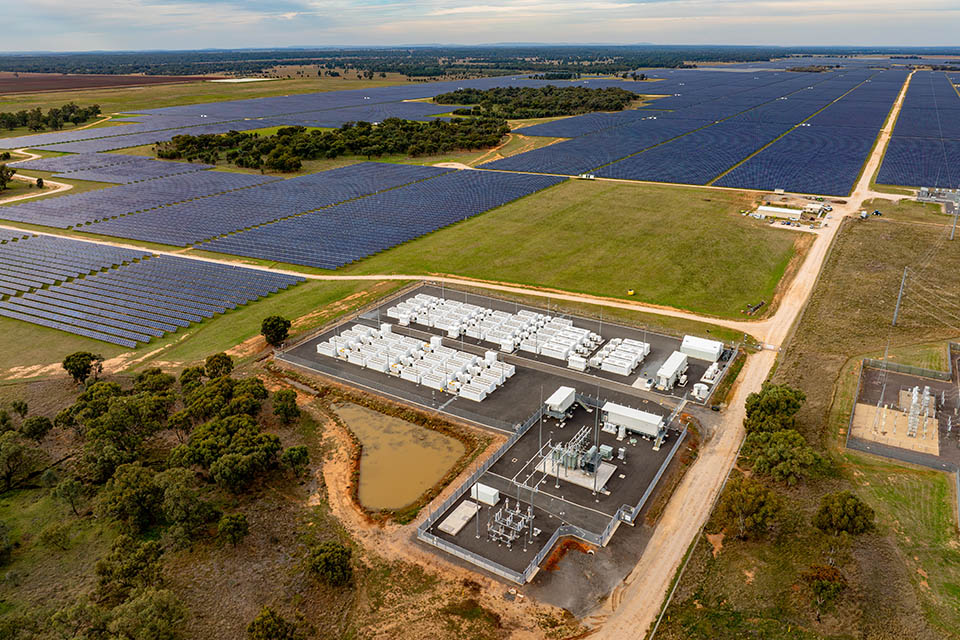 Octopus Group’s 275 MW Darlington Point Solar Farm powers 115,000 homes in New South Wales.
More investment needed to support Australia’s energy transition
However, the task ahead remains substantial. The Australian Energy Market Operator’s Integrated System Plan (ISP) sets out the least-cost pathway for Australia’s main electricity grid, the National Electricity Market.
The ISP estimates that almost 120 GW of utility-scale wind and solar capacity will be required by 2050, compared with around 23 GW operating today. This highlights the scale of investment required to replace retiring coal-fired generation, meet growing electricity demand and support Australia’s decarbonisation objectives.
Renewable electricity generation alone will not deliver Australia’s net zero ambitions. While the rapid build-out of wind and solar has reduced emissions from the power sector, further progress requires major investment in transmission, battery storage and grid modernisation to support a renewable-powered electricity system.
Initiatives such as Rewiring the Nation and the Capacity Investment Scheme are helping unlock transmission, generation and storage projects needed to support Australia’s transition to net zero.
Decarbonising hard-to-abate sectors
Opportunities are also emerging to support Australia to decarbonise hard-to-abate sectors.
‘From 2030, the march towards net zero will increasingly need to take place in heavy industry, aviation, mining and shipping,’ says Ross Cooper, Director, EMEA Investment, Austrade. ‘These sectors aren’t easily electrified. Australia will need other solutions.’
The need to decarbonise hard-to-abate sectors has driven a new wave of investment opportunities in sustainable aviation fuel, biomethane, offshore wind, critical minerals processing, recycling and rail infrastructure.
‘Sustainable aviation fuel is a clear investment opportunity,’ says Rolf Karst, Investment Director, Austrade. ‘European technology, industry expertise and capital can combine with Australia’s renewable resources and feedstock potential to decarbonise aviation, strengthen fuel security and build a globally competitive new industry.’
How Austrade can help
The Australian Trade and Investment Commission (Austrade) supports foreign investors to establish and expand operations in Australia. Our experts in Australia and around the world can help you through every stage of your investment journey.
We offer the latest industry insights, connections with key stakeholders and decision-makers, and virtual or physical site visits to Australia. Thousands of foreign businesses have worked with us to tap into the Australian market.
For information on investment opportunities in Australia, contact an Austrade investment specialist.
This article is the first in a five-part series examining the building blocks of Australia’s decarbonisation journey and the contribution European investors have made at each stage. The series will explore the evolution from renewable generation to grid infrastructure, industrial decarbonisation and emerging investment opportunities.
Subscribe to the Investment Update newsletter
Find out about new investment opportunities, insights and investor success stories across Australia.