Choosing to invest in Australia was a major strategic call for UK-based Octopus Group, one of the world’s largest clean energy investors.
Octopus has built a £6 billion renewable energy business with almost 300 assets across the UK and Europe. It was looking to replicate this success in other markets. In 2016, preparing for the company’s first international expansion outside Europe, Octopus considered potential markets in India, the United States and Australia.
Australia’s abundant natural resources and low country risk set it apart as an investment destination.
‘Obviously, Australia has a lot of land. We’ve got great wind and solar resources as well,’ says Sam Reynolds, Chief Executive of Octopus Australia. ‘We currently have a pretty supportive government of energy, which is great. All those fundamentals were quite enticing for us.’
After 6 years in London as head of investment at Octopus, Reynolds saw a massive, untapped renewable energy opportunity in Australia, with some key differences between Australia and other markets.
Australia was slower to adopt renewable energy than the UK, Europe and Asia. Unlike Europe, it didn’t have inter-connectors with other countries to tap into their power grids during low-energy periods, nor did it have a nuclear energy option. Most importantly, Australia’s coal-fired power stations are nearing the end of their lifespan.
‘Renewable energy is the only thing that can work in Australia,’ says Reynolds. ‘To get up and be generating in time to satisfy the energy demand, and with how much energy supply is coming out because of our ageing coal-fired power station fleet.’
On the back of these fundamentals, Octopus Australia entered the market in 2018, opening an office in Melbourne.
Austrade introductions open doors
While the opportunity was strong, Reynolds had limited time to make it work. ‘I think the initial budget was for 5 people in 3 months, which is not a lot of time to build a business,’ he says.
But by meeting with government, investors and advisers on the ground, Reynolds convinced the London office that there was a real business to be built in Australia, ‘...and that was something they could get behind and back for a longer term.’
Austrade provided vital support early on, facilitating those crucial introductions that helped shape the final decision.
‘The team at Invest Victoria was also very helpful, particularly in the early days when we were setting up in Melbourne,’ says Chris Hulatt, Co-Founder of Octopus Group.
‘Austrade was a big part of that, actually. They definitely opened those doors,’ Reynolds adds.
‘We were a complete unknown; no-one really knew Octopus. Even though I grew up in Australia, I’d had 15 years overseas, so no-one really knew me either. So, it was good to have that entry from Austrade to get things going.’
The unique agrisolar design of the Blind Creek Solar Farm and Battery
Octopus Australia currently has 2 renewable projects in operation on Australia’s east coast and another in development in Victoria. But it is the company’s landmark hybrid agrisolar project under construction in New South Wales that is breaking new ground.
The A$900 million Blind Creek Solar Farm and Battery is on more than 600 hectares of farmland near the town of Bungendore in the Southern Tablelands. Known for its diversified farming and agriculture, the region has become a growing hub for renewable energy.
‘Agriculture and energy are 2 of the largest emitters in Australia,’ says Kelsey Richardson, ESG and Sustainability Analyst at Octopus Australia. ‘On this one piece of land, we are tackling both of those with clean energy and regenerative farming, so that’s really exciting.’
The award-winning project will combine a 300 MW solar farm with co-located 243 MW battery storage. It has the capacity to power up to 120,000 homes and businesses.
The large-scale DC-coupled hybrid system will be one of the largest in Australia, with the batteries distributed throughout the solar array for greater efficiency.
Where livestock grazing is the most common agrisolar practice on solar farms, Blind Creek’s design integrates a fully operational, regenerative farm within the power plant. Elevating the solar panels higher above the ground will allow for tractor access and sheep grazing underneath.
The 600,000 panels will also provide critical shade for livestock in summer, reducing heat stress. The dew and moisture runoff will create a beneficial microclimate underneath, improving crop growth.
The site’s design incorporates other advanced agricultural features, including organic grass-fed lamb production, soil carbon sequestration, and a green-waste humus compost facility.
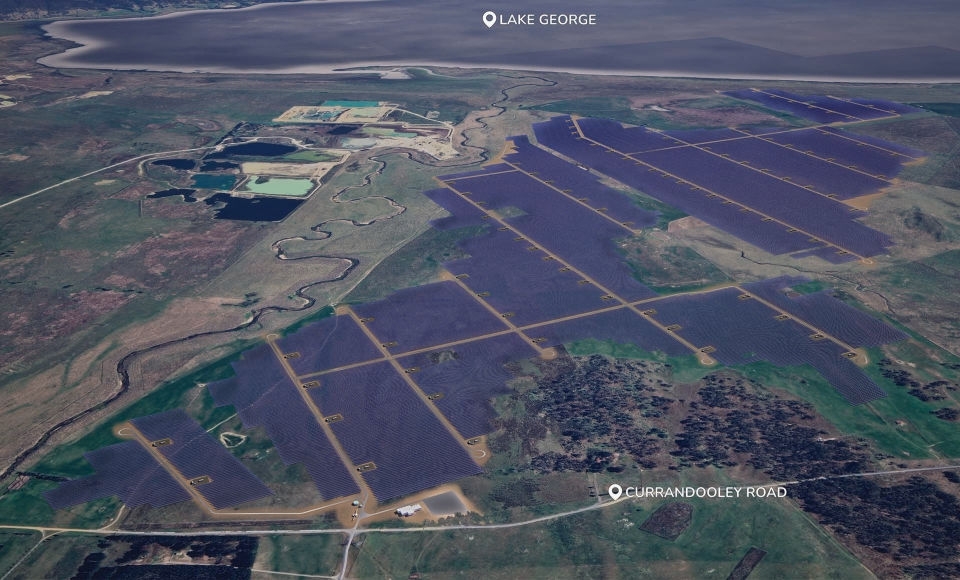
The Blind Creek Solar Farm in Bungendore integrates a fully operational, regenerative farm within the site. Artist’s rendition of the solar farm courtesy of Octopus Australia.
Community impact and engagement
Local farmer Dominic Osborne and his family have lived in the region for 150 years. Seeing the potential to combine renewable energy and regenerative farming on their land, the landowners put the Blind Creek project concept together themselves and brought it to market.
‘Blind Creek is so special because from the beginning you have people who are invested in the project. And being an intergenerational family in the region, they’re also very invested in the town and in the community,’ says Sonia Teitel, co-managing director of renewables at Octopus Australia.
‘We were honoured that they chose Octopus Australia as the people to work with to make the project happen.’
Leading discussions with their local community, the farmers set up neighbour agreements with other landowners likely to be impacted visually by the project.
When Octopus Australia came on board, it honoured these agreements, a method of benefit-sharing that is fast becoming standard practice across the renewable energy industry. In 2022, the project won the Clean Energy Council Community Engagement Award for its benefit-sharing scheme and agrisolar initiatives.
‘What’s really great about that scheme is the number of neighbours who have chosen to give their money to the local community through the Bungendore Community Foundation,’ says Richardson.
‘That demonstrates the community spirit, where good begets good, where it comes full circle.’
Engaging with the community right from the start is a vital part of the process for Octopus Australia. Reynolds says it’s in the organisation’s DNA to do the right thing, but it’s also important for the project’s success.
Octopus Australia uses a strict evaluation matrix to ensure a project will provide financial and non-financial value to the local community. This is coupled with the understanding that Octopus Australia will operate in the community for 35 years or more.
This means they need to deliver meaningful, ongoing outcomes to build trust and sustain community support over the entire lifespan of the project.
‘We develop, construct and own these projects for 40 years. We always think about our assets on a longer timeframe. That also means we’re working with the community, and we think about the community, on a longer timeframe,’ says Reynolds.
Preserving cultural heritage and biodiversity
The solar farm sits on the eastern edge of Lake George (Weereewa in Ngunnawal language), a place of high cultural significance for local First Nations people.
Before construction, Octopus Australia engaged several Registered Aboriginal Parties to visit the site to collect artefacts and establish exclusion zones. As the site is on private land, this is the first time local First Nations groups have had access to the area in over 150 years.
Octopus Australia and the landowners have agreed to build a permanent learning centre next to the lake after site construction is complete. This will establish a hub for local school and community groups to learn more about the site’s cultural heritage.
Small, local business Regenerative Landscapes Australia won the tender for visual mitigation at Blind Creek. This involves planting 87,500 native trees and plants along the site perimeter to minimise the development’s visual impact on surrounding properties.
Business owner Nick Huggins engaged a small wholesale nursery in Goulburn to grow the trees for the project, suitable for the local climate and bioregion. Following a staged, seasonal planting strategy, Huggins and his team will plant these in batches over 3 to 4 years to ensure a higher survival rate.
More than simply ticking a compliance box, this extensive tree-planting will double as a biodiversity offset, rehabilitating a barren, sandy area on the lake’s rim. This will create habitat for an endangered native bird, the white-fronted chat, and attract more native species to the area.
Huggins is also hiring local Aboriginal planters for the site’s landscaping to monitor for any ‘unexpected finds’ of artefacts and establish protocols during tree planting. The new vegetation will also help stabilise the soil and prevent any remaining artefacts from being washed away in future floods.
Firming for the future: the strategy to support net zero
It took time to find the right approach for the Australian energy market, with Octopus Australia initially bringing in a strategy that had worked well in the UK and Europe. ‘But when the government is buying your energy, you don’t have to do much innovation on that strategy,’ says Reynolds.
As this was not the case in Australia, Octopus Australia needed a different approach. Reynolds and his team soon scrapped the European business model and developed a new investment strategy to suit the Australian market.
To compete for large-scale institutional funding, Reynolds knew they needed to match the double-digit returns of traditional infrastructure assets like toll roads and gas pipelines.
This meant Octopus Australia needed 100% ownership of its projects to have full control over the lifecycle of the assets. The company also needed to provide a portfolio of reliable “firm energy” on demand. Solar or wind, which can only generate energy at certain times of day, were not the sole answer to the energy transition.
‘It’s like telling businesses just to put in a skylight and then funding a skylight. When companies want a light switch, they want to be able to turn the lights on 24/7, not just when the sun’s shining,’ Reynolds says.
By combining wind, solar, and battery storage into a single, firm energy portfolio, Octopus Australia could provide a more reliable, 24/7 energy product – one that directly replaces base-load coal and mimics the reliability of traditional energy retailers.
The move paid off. That investment strategy has now raised A$2 billion through the Octopus Australia Sustainable Investments Fund, with 60% coming from foreign investors and institutional funds, and 40% from local capital.
Octopus Australia has also delivered double-digit returns each year since the fund’s launch in July 2022.
‘We innovated our strategy to get institutional investors to invest in renewable energy in a very different way that we’re not seeing anyone else do in Australia,’ says Reynolds.
The future for Octopus in Australia
Today, Octopus Australia has grown to a team of over 70 across Sydney, Melbourne and Brisbane.
The vision has also grown from simply being a financial player in the market to integrating technical engineering, weather forecasting and grid planning.
‘We arrived in Australia with a lot of renewable energy experience, and then innovated,’ says Reynolds.
‘And the proof is that in just over 3 years, we’ve raised A$2 billion. You’re not raising that sort of money unless you’re innovating.’
Reynolds can see a big future for Octopus in Australia. ‘We want to continue to grow. I’d love us to stay nimble, continue to look at the market and change. Australia is not without its challenges, but it’s definitely been a great journey for us so far.’
How Austrade can help
The Australian Trade and Investment Commission (Austrade) supports foreign investors to establish and expand operations in Australia. Our experts in Australia and around the world can help you through every stage of your investment journey.
We offer the latest industry insights, connections with key stakeholders and decision-makers, and virtual or physical site visits to Australia. Thousands of foreign businesses have worked with us to tap into the Australian market.
For information on investment opportunities in Australia, contact an Austrade investment specialist.
Go further, faster with Austrade
Subscribe to the Investment Update newsletter to find out about new investment opportunities, insights and investor success stories across Australia.