Australia’s nascent biomethane (also known as renewable natural gas or RNG) industry is poised for significant growth.
This is due to the growing demand for low-carbon renewable gas in hard-to-abate sectors including building materials, chemicals, and food and beverage manufacturing. Australia’s goal to reach net zero by 2050 underpins its drive for industrial decarbonisation.
Australia is a natural candidate for biomethane adoption. The country has abundant feedstocks, thanks to organic residues from the agribusiness sector, which includes a A$13 billion wheat industry.
Biomethane can be used as a drop-in replacement for natural gas, which is widely used by industry, commercial businesses and households in Australia. The country’s gas infrastructure can be readily adapted for biomethane injection, and pipeline operators are already facilitating injection into the grid. This limits downstream transition costs for domestic and industrial customers.
Australia’s national strategic plans for energy now incorporate biomethane as a key enabler in the transition to low-carbon energy. The Electricity and Energy Sector Plan 2025 sets out a pathway to 2050 characterised by 3 major shifts in Australia’s energy system.
One of these is fuel-switching, where gas users will transition to renewable gases. Between 2030 to 2035, the plan envisages that renewable gases will increasingly support decarbonisation in hard-to-abate sectors. By 2050, renewable gases and fuel-switching will form an important part of the energy mix in Australia’s net zero economy. It’s why the Australian Government is supporting the scale-up of biomethane production as part of the Electricity and Energy Sector Plan.
Dr Frances van Ruth, Austrade’s Head of Net Zero Investment, says there are a range of opportunities in Australia’s biomethane industry for foreign investors.
‘Australia is looking for companies that have deep expertise in biomethane project development, site selection, feedstock contracts and grid integration,’ she says. ‘We’re also looking for businesses that have expertise in landfill gas and wastewater operations, which are highly transferable to biomethane injection projects.’
‘There is a strong case for deeper German-Australian collaboration on renewable gases,’ adds Özgür Tuna, Investment Director, Austrade Frankfurt. ‘Germany has decades of experience with biomethane regulation, grid integration, and certification. Australia can leverage this experience to accelerate the biomethane rollout, while Germany can benefit from secure, sustainable renewable gas supply options from a trusted partner.’
‘Japanese utility companies recognise biomethane as an important fuel for realising decarbonisation targets,’ says Kazuya Kuroda, Senior Business Development Manager, Austrade Osaka. ‘They are actively exploring renewable gas investment opportunities across Australia.’
Abundant feedstocks create competitive advantage
Biomethane makes a small contribution to Australia’s current energy mix. However, a study commissioned for Energy Networks Australia estimates that approximately 400 PJ per year of biomethane could be recoverable today from existing feedstocks. (Source: Energy Networks Australia, Biomethane Opportunities to Decarbonise Australian Industry, July 2025).
Australia’s continent-sized farming industry accumulates vast stocks of animal and agricultural residue. It includes:
- cereal residue, from Australia’s grain exporters
- horticulture residue, from Australia’s A$17 billion horticulture industry
- livestock residue, from farms across Australia
- sugar cane vinasse, from 3,700 sugar cane farms, mostly located in Queensland.
The Energy Networks Australia study estimates that the first 50 PJ p.a. of biomethane could be brought to market at between A$10 to A$27 per GJ. This is because feedstocks tend to be located close to consumption. Policy changes, technology improvements and new energy crops could increase the recoverable potential beyond the current 400 PJ.
Targeted support for biomethane
The Australian Government has taken action to promote future growth in the country’s biomethane industry. The Government’s Net Zero Plan (PDF, 26.9MB), released in 2025, identifies biomethane as a key part of Australia’s energy transition. In August 2025, Australia’s Energy and Climate Change Ministerial Council committed to work on developing a national renewable gas policy.
Regulatory changes will also incentivise adoption of biomethane.
From 1 July 2025, the National Greenhouse and Energy Reporting Scheme (NGERS) will recognise emissions reductions from certified renewable gases – including biomethane – when they are blended into existing supplies.
Meanwhile, Australia’s voluntary Product Guarantee of Origin (PGO) scheme will help track the emissions intensity of blended fuels. The scheme currently covers hydrogen production, but will expand over time to include biomethane, low carbon liquid fuels, and green metals.
State-based biomethane initiatives
A number of Australian states have introduced game-changing initiatives to promote local biomethane production and adoption.
In November 2025, the New South Wales Government’s Renewable Fuel Strategy expanded the NSW Renewable Fuel Scheme to include biomethane. From 2028, producers will be able to generate tradable certificates for every GJ of biomethane produced. This creates a financial incentive for biomethane production and supports projects to become commercially viable.
The strategy also provides up to A$130 million in funding (through the Net Zero Manufacturing Initiative), and a further A$40 million (under the Industrial Decarbonisation Initiative) to support production of renewable fuels from emerging technologies.
In Victoria, a Gas Substitution Roadmap outlines how the state will support hard-to-abate industries to decarbonise via renewable gases.
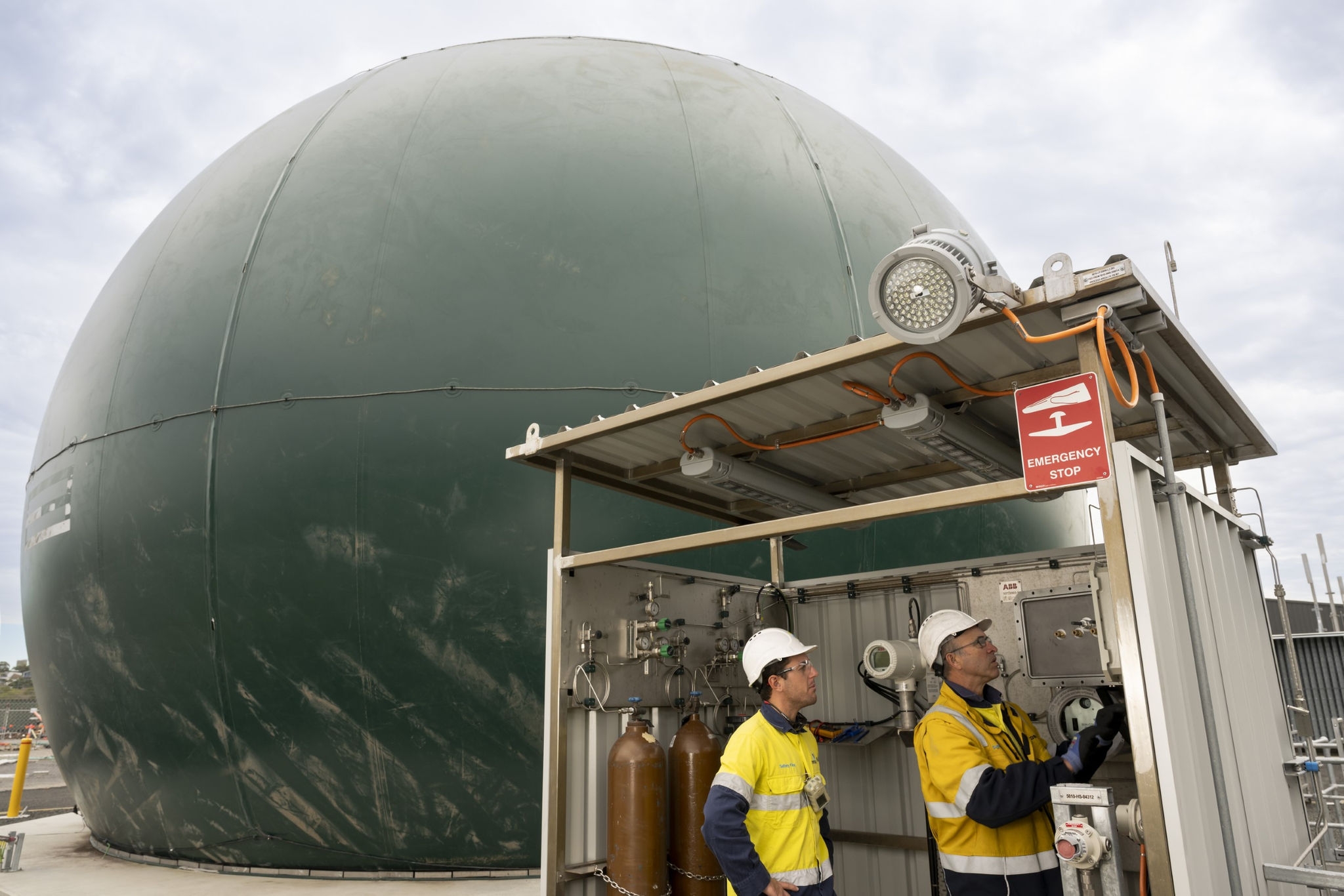
Sydney Water partnered with the state’s largest gas distributor Jemena to develop the Malabar Biomethane Injection Plant, the first demonstration project in Australia to inject biomethane into the gas network.
Biomethane projects in Australia
There is a growing pipeline of biomethane injection projects in Australia.
In NSW, Sydney Water has partnered with the state’s largest gas distributor Jemena to develop the first demonstration project in Australia to inject biomethane into the gas network. The Malabar Biomethane Injection Plant produces biogas from organic matter at Sydney Water’s wastewater treatment plant, which is upgraded to biomethane. Before development, biogas that could not be used on-site was flared, releasing carbon dioxide into the atmosphere.
In addition, several Australian companies are pursuing biomethane injection projects.
Optimal Renewable Gas aims to develop grid-scale biomethane plants for distribution through the existing gas network. Its 3 projects include the Goulburn Valley Bio Hub, Westbury Bio Hub and Griffith Bio Hub.
Victoria-based Valorify is developing 3 major projects that will process agricultural waste from crop-growing farming districts. The company’s Riverina Bioenergy project aims to inject 4 PJ of biomethane into the NSW gas network.
In South Australia, Delorean Corporation’s SA1 Salisbury Bioenergy Plant will be the first bioenergy facility in Australia to produce mains-grade biomethane and biogenic CO2 from processed commercial and industrial organic waste. The biomethane will be injected into South Australia’s gas network.
There are many more biomethane projects in the pipeline across the country.
How Austrade can help
The Australian Trade and Investment Commission (Austrade) supports foreign investors to establish and expand operations in Australia. Our experts in Australia and around the world can help you through every stage of your investment journey.
We offer the latest industry insights, connections with key stakeholders and decision-makers, and virtual or physical site visits to Australia. Thousands of foreign businesses have worked with us to tap into the Australian market.
For information on investment opportunities in Australian biomethane, contact an Austrade investment specialist.
Go further, faster with Austrade
Subscribe to the Investment Update newsletter to find out about new investment opportunities, insights and investor success stories across Australia.