State-of-the-art, ultra-high bandwidth wireless laser communication at a fraction of the cost of fibre. A near-instant open communication line from Australia to anywhere in the world – or floating above and beyond it. It’s an appealing promise for Australian enterprises looking to enhance their connectivity across the outback – and Singapore’s Transcelestial can deliver.
Transcelestial is changing how Australia connects. It’s already kicked this mission into gear by launching a breakthrough wireless laser communication technology in the Northern Territory.
The company joins several other firms including Atomionics and Equatorial Space Systems that have expanded to Australia. The great tech migration is fuelled by increasing collaboration and innovation efforts between Singapore and Australia. Australia’s remote northern landscape also makes for the perfect testing ground.
‘Australia has unique challenges when it comes to bridging the digital divide, which Transcelestial has an excellent track record resolving,’ says Transcelestial CEO and Co-Founder Rohit Jha. ‘While our terrestrial solutions can help, using space and drones to not only support people and industries but also provide secure connectivity for national security is very exciting to us.’
Supporting Australia’s challenging communications needs
For many people, lasers (an acronym for ‘Light Amplification by Stimulated Emission of Radiation’) and communication might not go together. Surgery and skin treatment techniques, welding and construction, or barcode scanners and printers are common daily uses that come to mind, but the technology’s applications in communication are a sign of the future.
Transcelestial is one of the world’s largest producers of wireless laser communication technology. Its infrastructure supports both domestic and national ambitions. The built-in redundancy capabilities of laser technologies address natural or human-made disruptions – an all-too-common occurrence across Australia’s often uncompromising conditions.
Australia’s demanding geography, high-stakes national security resilience and needs, and its deep research and development ecosystem all act as an accelerant for the firm’s development and testing.
‘Australia has vast coastlines that are difficult to monitor and protect at scale, especially across sparsely populated regions,’ says Transcelestial CTO and co-founder Mohammad Danesh. ‘At the same time, national connectivity risk is concentrated through a small number of subsea fibre routes. If those routes are disrupted, critical digital infrastructure can be impacted quickly, and existing fallbacks like satellite internet have bandwidth limitations.
‘Traditional radio frequency (RF) links also introduce security vulnerabilities because they are easier to jam or intercept,’ he adds. ‘Laser communication offers secure, high-bandwidth connectivity layer that can support resilience planning for population centres and sensitive operating environments.’
Transcelestial’s plans do not end in the Northern Territory. Although northern Australia is strategically important, the company is exploring potential sites across other states including setting up optical ground stations in western, eastern, and central Australia.
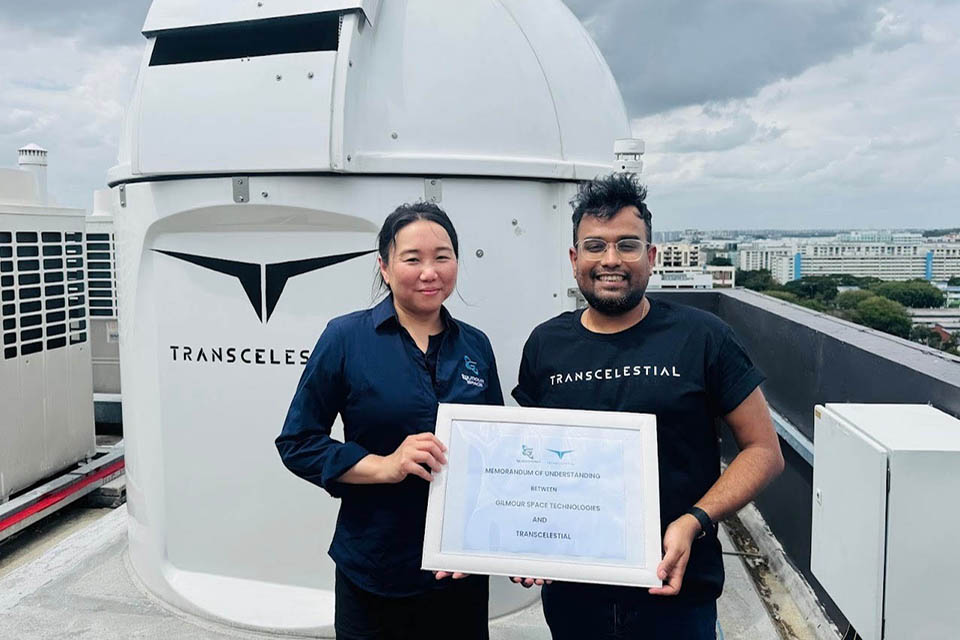
Transcelestial and Australia’s Gilmour Space signed an MoU to use laser communications capabilities to advance how data moves on satellites.
An Australian-first ground station
Transcelestial is pioneering Australia’s first end-to-end commercial space-to-ground laser communications network. Unlike ground-only optical infrastructure, Transcelestial’s deployment is part of a proprietary end-to-end system spanning both space and ground. The company builds and operates the laser communications terminals onboard satellites in orbit as well as the Transcelestial's Optical Ground Station on the ground, enabling a full optical link between the two.
Its latest laser communications system is already in orbit aboard the 6G StarLab mission and is designed to connect directly with its Australian ground station, closing the optical loop. With additional satellites set to launch later this year and another operational optical ground station already established in Europe, the Australian deployment marks a key step in building Transcelestial’s broader global network for ultra-secure, high-speed space-to-ground communications.
The landmark TMOGS facility can test a new type of ground station that can be easily changed or upgraded. Clear weather, low light pollution, and stable atmospheric conditions make Alice Springs an ideal location to trial Transcelestial’s technology.
Australia’s remote connectivity challenge is often framed as a ‘last-mile problem’, but in practice it’s also a backhaul and resilience problem.
To combat this, Transcelestial has 2 pathways to consider: either ground links for regional extension (when fibre is nearby), or optical ground stations for very remote coverage (when fibre is not nearby).
Danesh says, ‘There are large regions where fibre is too slow, too costly, or too exposed to disruption. Transcelestial’s laser communications provides 2 ways to extend a secure, high-bandwidth layer into those regions, depending on distance from existing fibre.’
Selecting Australia also means new job opportunities are created.
‘Directly, deployments rely on local installation and maintenance partners, and optical ground stations involve on-the-ground construction, integration, and bespoke operations,’ says Danesh.
‘If programs scale with government or enterprise support, this can extend into more sustained technical roles across research and development, field engineering, network operations, and local assembly workstreams.
‘Indirectly, improved high-quality connectivity enables economic participation: remote workers, small businesses selling online, access to training and services, and local enterprises that become viable once bandwidth and reliability stop being limiting factors.’
Australian research partnerships
Even before this milestone, Transcelestial had a breakthrough – proving it was possible to deliver 5G connectivity wirelessly via its laser technology at University of Technology Sydney (UTS).
Transcelestial has engaged and explored collaborations with multiple institutions beyond UTS, including work with the University of Western Australia (plus a grant proposal related to coastal secure connectivity), and discussions with additional institutions including Curtin, Edith Cowan University, Charles Darwin University, the University of Sydney and others about research facilities and hosting sites.
Danesh points to Australia’s globally renowned and advanced research ecosystem, commenting on how it ‘is highly regarded internationally, particularly in fields relevant to laser communications such as optics and photonics, with strong talent pipelines and increasing support through grant mechanisms at both federal and state levels. In many optics, laser and photonics sub-domains, Australia is widely considered to be among the global leaders in research quality.’
Beyond enhancements for earthly enterprises, Transcelestial is aiming to upgrade defence assets with ground-to-drone laser capabilities. The company also wants to pioneer Australia’s first laser-based gateway to space communications via the Northern Territory.
Danesh says the company is only just getting started.
‘Near-term, Transcelestial is pursuing Australian space missions in 2026, beginning with Gilmour Space who recently selected Transcelestial’s lasers to unlock high-speed satellite communications for the AI era.
‘We’re also progressing discussions that could lead to at least one, and potentially up to 3, optical ground stations across Australia. Together, these steps support a national approach.’
How Austrade helped
Austrade played a pivotal role in supporting Transcelestial’s expansion into Australia.
Through key investor introductions, Austrade connected Transcelestial to the Darwin Innovation Hub for its flagship CrocPitch event. The company caught the eye of Paspalis Capital, resulting in further investment to build an Australian base. NTT Finance and Paspalis Capital co-led the most recent multimillion-dollar investment round for Transcelestial.
Austrade has also helped Transcelestial explore opportunities in defence thanks to the technology’s dual-use potential. The Northern Territory Government supports tech companies entering the region and startups through co-investment, streamlined site identification, and partnerships with local industries, and was another connection formed through Austrade’s Australian and Singapore-based teams.
Go further, faster with Austrade
Subscribe to the Investment Update newsletter to find out about new investment opportunities, insights and investor success stories across Australia.