A drone squadron flies overhead in formation across a stretch of red dirt near Tennant Creek in the Northern Territory. The outfit is silently surveying the ground, spinning webs of data with pinpoint accuracy on what lies below: rich veins of copper.
It’s Singapore startup Atomionics’ cutting-edge technology for finding critical minerals; materials that would have previously taken a decade to identify, now only need a fraction of that time to uncover.
By collecting crucial data for finding the critical minerals needed for the energy transition and modern-day technologies, Atomionics is a genuine quantum leap for subsurface exploration.
Gravio ends the guessing game
Turning back the clock, Sahil Tapiawala stopped by cold atom physicist Ravi Kumar’s lab to discover a setup occupying an entire room. Gadgets and gizmos connected and hosted atoms at microkelvin temperatures, marking the inner workings of what would be Atomionics’ quantum sensor, GravioTM.
For roboticist and electrical engineer Tapiawala, it was ‘a mind-blowing moment’ – sparking the duo’s formation of Atomionics and setting their sights on subsurface exploration across Earth. And, hopefully someday, to the moon, Mars and beyond.
Atomionics’ Gravio and AI geologist, ORE-OTM, work in tandem to create detailed 3D models of the Earth’s subsurface. The models contain detailed geophysical snapshots of everything beneath the surface: resource locations, earthquake data, volcanic activity and more. It also enables activities like GPS-free navigation and positioning.
BHP, OpenAI co-founder Pamela Vagata and mining executive Mikhail Zeldovich are just some of the influential deep-tech investors convinced that Gravio is a groundbreaking technology.
Making mining more efficient and less intrusive
There’s an increasing global demand for metals required for future energy sources. ‘In the next 12 years, we need as much copper as we did in the last 120 years. Similar statistics hold true for literally every critical mineral,’ said Tapiawala in a 2025 interview with Mining Magazine.
Gravio aims to answer a complicated problem with global implications – how can mining be made less intrusive, more efficient, and for the benefit of all? Discovery, infrastructure and planning to retrieve subsurface materials is expensive, drawn-out, and has environmental and cultural impacts. Cue the need for a ‘revolutionary technology’, as Tapiawala aptly calls it.
Atomionics’ specialised cold atom interferometry is a simple solution on the surface with a complex scientific process underneath. The portable, basketball-sized ‘Gravio’ is a high-speed, high-quality subsurface quantum gravimetry mapping device – powered by ultra-sensitive quantum sensors with AI-driven interpretation. A recipe for success sometimes requires an impressive list of ingredients.
Working with Australia’s elite miners
The opportunity to trial Gravio in Australia with world-leading miners was compelling, according to Tapiawala. Australia’s mining sector is a cornerstone of its economy, contributing 14.3% of GDP (A$250 billion) in 2024.
‘Australia is one of the world’s foremost of minerals and energy,’ Tapiawala says. ‘It is home to some of the world’s largest and most complex mining projects, including critical minerals that can be difficult to detect and extract. We saw how Gravio could play a crucial role in these projects.’
Atomionics was correct: the Australian mining sector has welcomed the forward-thinking, non-invasive, cutting-edge technology. The company secured the Asia–Pacific’s regionally coveted Croc Pitch grand prize of A$500,000 in 2022 at the Darwin Innovation Hub.
The prize supported Atomionics to set up its operations centre in the Northern Territory. The company is adapting its solutions for the Australian market to enable large areas of land to be mapped rapidly. The Northern Territory is the perfect testbed for this work.
New partnerships have already formed. Large-scale operators like BHP’s Ventures initiative are putting Gravio to the test, which will help find critical minerals like copper, lithium and nickel.
‘Atomionics’ groundbreaking technology puts Australia at the forefront of sustainable mining solutions, transforming the future of resource discovery and directly contributing to Australia’s economic growth and technological leadership,’ says Tapiawala. ‘The Northern Territory expansion is strategic because it has the potential to become a global hub for critical minerals and yet remains underexplored.’
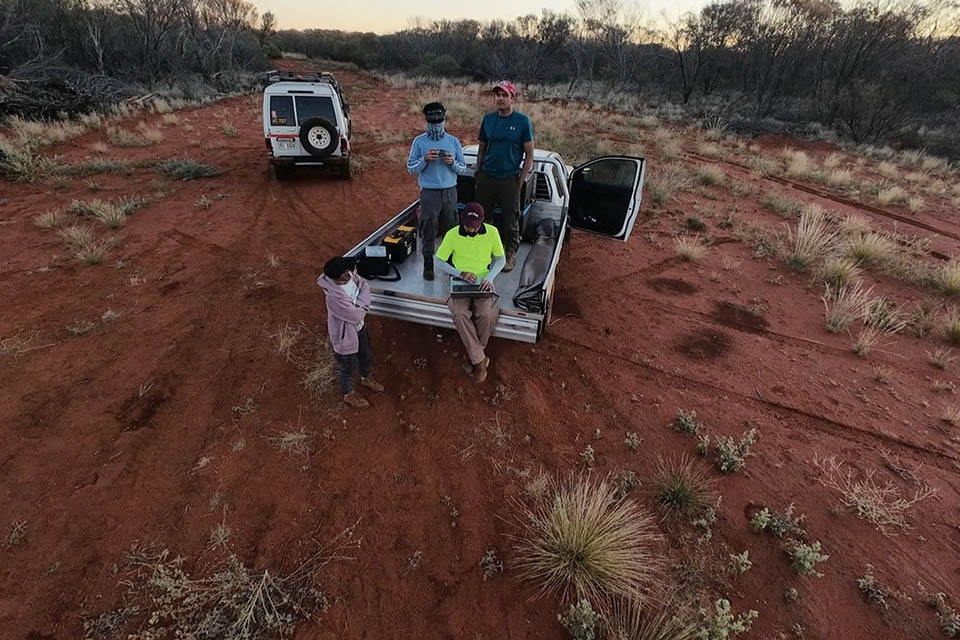
Atomionics is working with Australian miners to test Gravio, its groundbreaking quantum sensor.
Atomionics received investment from the Paspalis Co-investment Fund, a joint initiative of Australian VC fund Paspalis Capital and the Northern Territory Government’s Local Jobs Fund. The investment reflects the local support for Atomionics’ commercial potential and commitment to operating in the Northern Territory.
‘Supporting Atomionics aligns with our vision of fostering technological innovation in the Northern Territory,’ says Paspalis CEO Harley Paroulakis. ‘Their quantum technology is set to revolutionise mineral exploration and strengthen Australia’s role in securing global critical mineral supply chains.’
The uses for this technology extend beyond the world of mining, oil and gas – for example, in carbon sequestration – amplifying Australia’s efforts to lead net zero and economic security in the region.
How Austrade helped
Austrade was the catalyst for Atomionics’ move to the Northern Territory.
Through the Northern Territory Government’s in-country representative, Austrade introduced Atomionics to the Darwin Innovation Hub and Croc Pitch – a key touchpoint for the firm’s first steps in Australia.
Austrade organised networking sessions and business-to-business meetings with investors, provided promotional support and publicity for events, facilitated introductions to corporate service providers, and assisted with visa information to help Atomionics set up its Australian entity.
Alongside the Northern Territory Government, Austrade has also facilitated Letters of Support for Atomionics’ Commercialisation and Growth grant application, part of the Australian Government’s Industry Growth Program.
Shared interest in digital transformation drives bilateral partnership
Atomionics joins a wave of change underway across Australia and Singapore’s bilateral trade in critical technologies. The company is among a cohort of Singaporean future-shapers to recently land in Australia, including Equatorial Space Systems and Transcelestial. Once Atomionics’ initial deployment and test-bedding activities have concluded, more job opportunities and partnership possibilities will open across the region.
‘The economic and technological partnership between Singapore and Australia is deep, multi-faceted, and continually expanding, driven by shared strategic interests in digital transformation, national security and regional stability,’ says Tapiawala.
‘Singapore and Australia can jointly lead the global quantum revolution by fusing Singapore’s position as a pre-eminent deep-tech hub and investment gateway with Australia’s massive resource base and critical need for sovereign supply chain security.’
Find out more about opportunities in Australia’s technology sector.
Go further, faster with Austrade
Subscribe to the Investment Update newsletter to find out about new investment opportunities, insights and investor success stories across Australia.