Optain’s retinal screening technology combines advanced robotics and AI analysis to screen for common eye conditions such as diabetic retinopathy.
Optain’s solution is specifically designed to integrate seamlessly into primary care workflows. The test is non-invasive, with screening complete in minutes. The retinal camera is portable, battery-powered, and weighs about 2kg, meaning it can slot into existing clinic operations or travel to remote communities.
‘It makes screening more accessible,’ says Jeff Dunkel, Optain’s Chief Executive Officer.
‘It allows us to extend access to vision-saving screening to communities where this care just wasn’t possible previously.’
Primarily, Optain’s focus is screening for diabetic retinopathy, a complication of diabetes, which can cause blindness if not treated early. People with diabetes should be screened for retinopathy every 12 months, explains Dr. Zachary Tan, President of Optain. But access can be limited by postcode or finances.
‘Despite this condition being eminently treatable if we catch it early, fewer than 40% of patients actually get screening at the recommended interval,’ Tan says.
‘In both Australia and the US, diabetic retinopathy remains the most common cause of preventable blindness among working-age adults.’
A multinational growth story
Currently, Optain retinal cameras are operational in about 250 sites, globally. Within 12 months, Tan expects that to increase to 1,000.
In the US, retinal cameras will operate across 8 major health systems, which collectively deliver 5% of all the country’s healthcare activities.
The business has also raised almost A$60 million in capital from leading US venture capital firms like Insight Partners, and 7 health systems that are also rolling out the technology.
Now, Optain is reinvesting heavily in Australia, and plans to roll out to GPs and clinics, expand its research and development (R&D) hub, and establish an APAC headquarters in Melbourne.
Optain has already partnered with private health insurer Bupa, as it grows its network of primary care clinics. Tan is in talks with a number of other primary care providers.
The investment is expected to create 49 jobs, and lead to A$10 million in R&D spending in the years ahead. It will also support local AI capabilities in medtech.
‘In the global AI race, there is a lot of strategic value in developing this capability locally,’ Tan explains.
‘We hope by investing in Australia, we will create great new jobs here, generate export earnings, and most importantly, scale the impact of our science globally.’
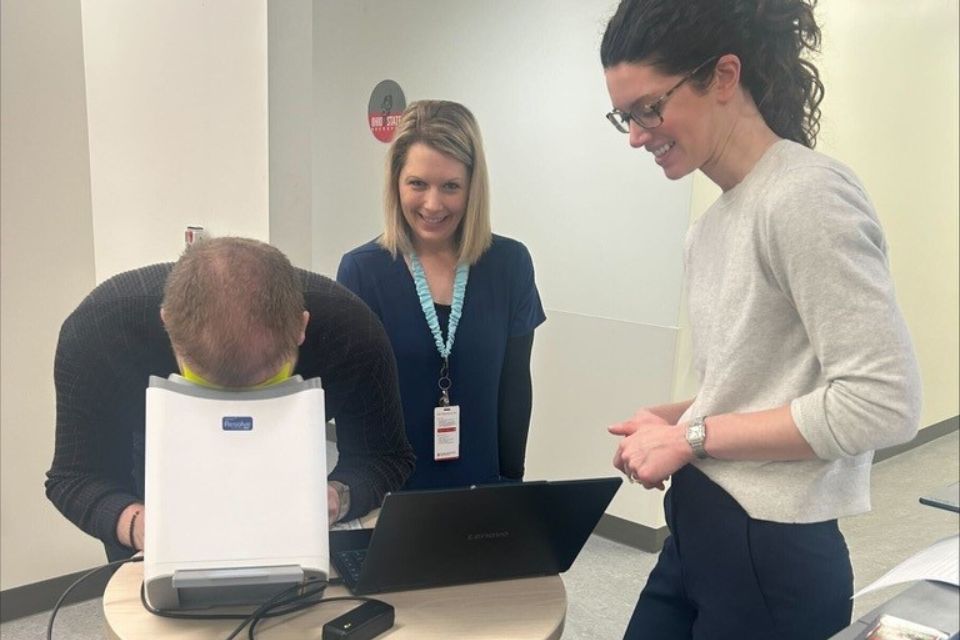
Retinal screening at OSU Outpatient Care in Ohio, United States.
Australia’s strength in medtech
Optain’s investment builds on existing foundations in Melbourne, Victoria, which will grow as its global hub for R&D and engineering.
Australia is now the right growth market, too. For Tan, that’s largely down to the research and education ecosystem, and the people who power it.
‘One of the things we’re so strong at in Australia is the calibre of our medical research,’ he says.
‘Optain was born from Australian science, and then it has scaled and commercialised globally. We’re really proud of that.
‘It’s the calibre and density of the talent that has really encouraged us to double down on our investments.’
Austrade support at home and away
Given its unique relationship with Australia, Optain has something of a unique relationship with Austrade, too.
Austrade in the US has supported the business with introductions and profile-building — helping tell the story and showcase the impact. This includes at events like the Super Summit in the San Francisco Bay Area and the Prime Minister’s Innovation Showcase in Washington D.C.
In Australia, too, the Austrade team has connected Optain to key industry players and offered advice around accessing healthcare systems in a market that operates very differently to the US.
‘Austrade has been really valuable as we think about how to invest back into Australia; how to be really thoughtful about where to invest,’1 Tan says.
‘They’re just wonderful connectors,’ he adds. ‘Having the backing of Austrade and, by extension, the Australian Government, is really helpful.’
The window to the body
Tan sees Australia as a jumping-off point to expand throughout the APAC region. However, he’s also committed to establishing retinal screening as a standard for primary care locally.
The team is working towards screening for other conditions, using the eyes as “the window to the body”, for broader health screening.
The eye is the only point in the body where we can see blood vessels and neural tissue, without a needle or radiation. Those blood vessels are also sensitive to change, and AI analysis can identify those changes, and what they mean.
This means the tech is designed to help identify patients at risk of heart disease2, and may in the future also help identify those at risk of kidney or neurological diseases. And that means they can access preventative treatment sooner.
‘We can unlock the ability to screen for so much more through the eye. That is what we’re really excited about,’ says Tan. ‘In a country as vast as Australia, the ability to detect these conditions locally within primary care can help us reach patients earlier, when treatments are most effective.’
How Austrade can help
The Australian Trade and Investment Commission (Austrade) supports foreign investors to establish and expand operations in Australia. Our experts in Australia and around the world can help you through every stage of your investment journey.
We offer the latest industry insights, connections with key stakeholders and decision-makers, and virtual or physical site visits to Australia. Thousands of foreign businesses have worked with us to tap into the Australian market.
For information on investment opportunities in Australia, contact an Austrade investment specialist.
References
- Ha SK, Gilbert JB, Le E, Ross C, Lorch A. Impact of teleretinal screening program on diabetic retinopathy screening compliance rates in community health centers: a quasi-experimental study. BMC Health Services Research. 2025 Feb 26;25:318. doi: 10.1186/s12913-025-12472-8. PMID: 40011921; PMCID: PMC11863591.
- This product is not currently available for sale in Australia. Australian Register of Therapeutic Goods (ARTG) application pending.
Go further, faster with Austrade
Subscribe to the Investment Update newsletter to find out about new investment opportunities, insights and investor success stories across Australia.