Australia is inviting investors to strike while the (green) iron is hot. The country is building a green iron industry with the scale and resources to support the transition to sustainable steelmaking.
Our competitive advantage rests on 4 key assets: vast iron ore reserves, abundant renewable energy sources, strong government support, and deep research and development (R&D).
Australia has the world’s largest iron ore reserves, almost half of which is magnetite, a high-grade ore well suited to low-emissions green iron production.1 Work on the other critical input – green hydrogen – is progressing steadily, with 60 projects in development. Investment in renewable energy continues to grow, with the Australian Government committing to A$18.2 billion in net-zero spending over the next decade.2
The Australian Government recognises Australia’s potential to become a cost-competitive green metals producer. Its Future Made in Australia plan identifies green metals as a priority sector critical to Australia’s net zero transformation and its industrial future.
The Australian Government has allocated significant funding for green metals projects, including a A$1 billion Green Iron Investment Fund. The fund includes a A$500 million National Development Stream to help fund early-stage capital projects. This is on top of the A$750 million set aside in the Future Made in Australia Innovation Fund for green metals.
In addition, up to A$3 billion of Australia’s A$15 billion National Reconstruction Fund will be used to finance renewables and low-emissions technologies that will underpin green iron manufacturing.
‘Australia’s ore reserves, mining expertise, renewables projects and government support are driving the development of a green iron industry,’ says Abdul Ekram, Lead – Hydrogen and Green Metal, Austrade. ‘Now is the time to explore investment and partnership opportunities as the industry gathers momentum.’
Mining large hematite and magnetite reserves
Australia is a natural choice for green iron projects as it has vast reserves of two key ores.
- Hematite – also known as direct shipping ore (DRO) – has been the dominant iron ore mined in Australia since the 1960s. Today, Australia has the world’s largest hematite mining operations. Most hematite is mined in Western Australia.
- Magnetite deposits occur across Australia. Reserves stand at approximately 12.8 billion tonnes and are spread between South Australia (5.7 billion tonnes, 44%), Western Australia (4.8 billion tonnes, 37%) and New South Wales (2.3 billion tonnes, 18%).3
Australia is the top supplier of iron ore to China and Japan, 2 of the world’s top 3 steel producers. Investors can tap into these established markets and buyers for green iron offtake opportunities.
This unique combination of scale, quality, industrial-scale production capacity and established exports positions Australia as a highly competitive destination for green iron investment.
Australia’s green hydrogen potential
Prospects in green steel are closely tied to locally manufactured green hydrogen, which is another strategic priority for the Australian Government. The National Hydrogen Strategy sets out a path for Australia to become a future producer of industrial-scale hydrogen and its derivative products.
Australia’s abundant wind and solar resources underpin our green hydrogen potential, positioning the country as a reliable exporter to major clean‑energy demand hubs in Asia, including Japan, Singapore and South Korea. The International Energy Agency recognises Australia – alongside Europe – as a global leader in the development of the hydrogen industry.
Australia has around 60 hydrogen projects4 in development, laying the foundation for an export-oriented green steel industry. In May 2026, the Australian Renewable Energy Agency shortlisted 7 projects for round 2 of the Hydrogen Headstart program. These projects will now submit a full application for funding assessment.
The Hydrogen Production Tax Incentive, which is a refundable tax offset, further supports investment in green hydrogen.
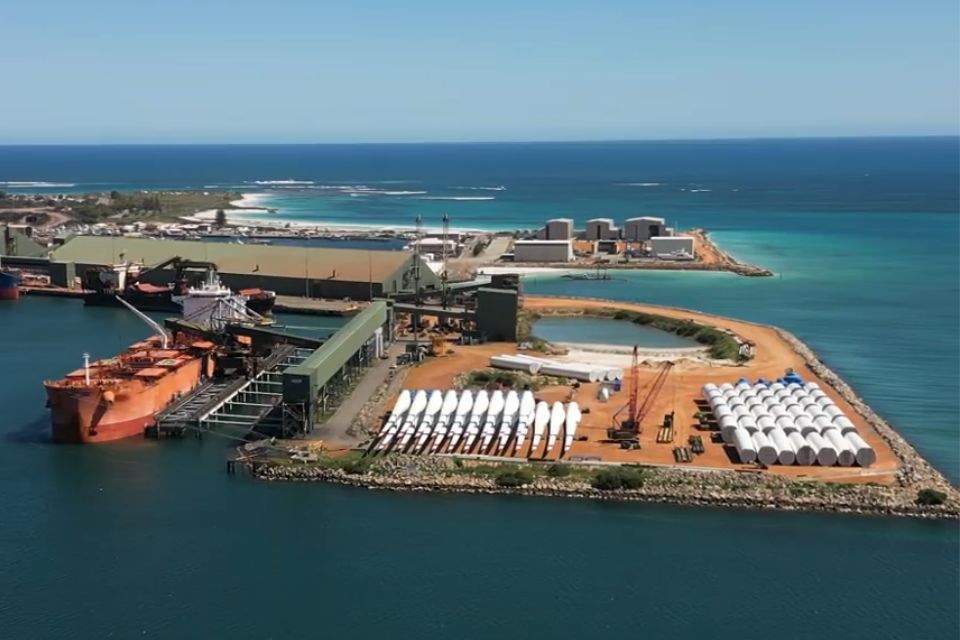
The PGS Geraldton Green Iron project in Western Australia will use hydrogen to process local magnetite ore into Direct Reduction Iron (DRI). Image courtesy of PGS.
Key projects in Australia’s green iron industry
Multiple green iron projects are underway across Australia. Potential investors can track the progress of these projects using the Australian Green Iron Tracker.
- Hawsons Iron Ore Project (New South Wales, Hawsons Iron Ltd.). The A$1.4 billion project aims to produce high-grade, low-emissions magnetite. The company’s dry processing technology produces 68.6% Fe magnetite concentrate. Pre-feasibility studies were completed in December 2025.
- PGS Geraldton Green Iron Project (Western Australia, Progressive Green Solutions). Located in Geraldton, this is a large-scale project that will use hydrogen to process local magnetite ore into Direct Reduction Iron (DRI). The mixed plant will also produce iron ore pellets. Phase 1 includes a 7 Mtpa plant, with 2.6 GW of wind/solar capacity. The plant should produce 180,000 tonnes of green hydrogen per year. PGS recently executed an offtake agreement and partnership with Thyssenkrupp in Germany.
- Razorback and Iron Peak (South Australia, Magnetite Mines). The pre-development magnetite iron ore project aims to produce DRI products via low-carbon production. The project will target 5 Mtpa and will leverage South Australia’s renewables-weighted grid.
- NeoSmelt Green Iron Pilot Plant (Western Australia, BlueScope, BHP, Mitsui, Rio Tinto, Woodside Energy). The proposed plant would produce 30,000 to 40,000 tonnes of molten iron a year, with operations planned to begin in 2029. It will be the largest pilot Electrical Smelting Plant in Australian history. The project would initially use natural gas, but trial hydrogen to process iron ore into DRI. The Western Australian Government has recently declared this as one of the 5 priority projects in WA’s first State Development Area (SDA) under new powers aimed at accelerating industrial development, cutting approvals timeframes and diversifying the state’s economy.
Investment opportunities in Australian green iron
The Australian Government aims to leverage high standards, local R&D and renewable hydrogen to help industry move up the iron/steel value chain. Expansion creates multiple opportunities for overseas investors.
- New magnetite mines and DRI facilities to produce intermediate iron/steel products for exports. The current showcase project Collie Steel Mill is Green Steel of WA’s A$1.6 billion project with Italy’s Danieli Group. This includes a DRI plant that will make intermediate iron/steel products for export.
- Decarbonising steelmaking using electric arc furnaces (EAFs). Australian researchers are exploring ways to process magnetite into green steel using H2-DRI-EAFs pathways, powered by hydrogen using Australian wind-solar energy, in the existing steel industry.
- Opportunities to partner with local R&D organisations to develop new hematite processing technology. Around 96% of Australian iron ore exports are hematite. Australian scientists and policy makers are keen to develop new DRI and smelter technologies to process Australian hematite for export.
Partnering with Australian R&D
Australian universities and science organisations are working on innovative solutions to reduce the cost of manufacturing green iron, and investors can work hand-in-hand with these entities to progress research and development.
Australia’s national science agency, the Commonwealth Science and Industrial Technology Organisation (CSIRO), works routinely with the private sector to develop practical solutions to industry challenges.
For instance, CSIRO is trialling an electrolyser that uses steam rather than water to produce green hydrogen at BlueScope’s Port Kembla steel plant in New South Wales. The technology has run without incident for more than 1,000 hours.
Australia also has a network of Cooperative Research Centres (CRCs) that link academic researchers with industry to solve a wide variety of challenges. The HILT CRC, an industry, academia and government partnership, is leading translational research and development of new technology and solutions to decarbonise heavy industry. The CRC is collaborating with major industry players on research projects to produce green iron products from magnetite, hematite/goethite ores.
Australia: a trusted investment destination
In a turbulent world, Australia offers investors a stable, open and well-regulated business environment. Global rankings consistently place Australia among the world’s leaders for credit ratings, reflecting strong economic fundamentals and investor confidence.
Euromonitor ranks Australia third globally for trade freedom5, underscoring its long‑standing commitment to open markets and strong international integration. Australia has 19 free trade agreements (FTAs), and recently announced the conclusion of negotiations for an FTA with the European Union.
These advantages are reinforced by Australia’s resilient economy and its high‑quality institutions, which support innovation, effective governance, and predictable policy settings. Together, these factors position Australia as a compelling location for long‑term, sustainable investment.
How Austrade can help
The Australian Trade and Investment Commission (Austrade) supports foreign investors to establish and expand operations in Australia. Our experts in Australia and around the world can help you through every stage of your investment journey.
We offer the latest industry insights, connections with key stakeholders and decision-makers, and virtual or physical site visits to Australia. Thousands of foreign businesses have worked with us to tap into the Australian market.
For information on investment opportunities in Australia, contact an Austrade investment specialist.
References
- Geoscience Australia (2026), Australia's Identified Mineral Resources 2025
- fDi Markets (2026), privately provided dataset, extracted in March 2026
- Institute for Energy Economics and Financial Analysis, Australian Green Iron Tracker, last accessed May 2026
- Geoscience Australia (2026) Australian Hydrogen Projects dataset
- Euromonitor International Limited (2026)
Go further, faster with Austrade
Subscribe to the Investment Update newsletter to find out about new investment opportunities, insights and investor success stories across Australia.