Thermo Fisher Scientific’s investment in Australia is part of a story that’s more than a century long.
Its roots trace back to historical Australian laboratory supplier, Selby Scientific, founded in Melbourne in 1897 and later acquired by Biolab. That history culminated in Thermo Fisher’s A$175 million acquisition of Biolab in 2009, marking the company’s entry into the Australian market.
Originating in the US, Thermo Fisher is built on a foundation of such acquisitions and mergers. Today, it’s one of Australia’s leading scientific suppliers, supporting science at every stage, from early discovery through to clinical diagnostics and commercial manufacturing.
‘Australia has historically been an attractive destination for investment because of its world-class science and research excellence,’ says Jo Broughton, Thermo Fisher’s Vice President and General Manager for the ANZ region.
‘Over time we’ve invested and expanded with manufacturing, research partnerships and local capabilities. Today our footprint represents that kind of long-term investment story.’
But this is not just a story of business expansion – Thermo Fisher saw an opportunity in Australia for scientific excellence. By bridging the gap between laboratory research and clinical practice, the company supports customers as they translate scientific advances into tangible outcomes.
‘In Australia, that full innovation cycle is real. You can support customers to solve challenges that go through to real-world impact,’ says Broughton.
A collaborative science ecosystem
Thermo Fisher’s drive to accelerate scientific discovery has led to close partnerships with top-tier Australian research hubs and institutes, including CSIRO and Australia’s leading universities.
For example, Monash University and the University of Melbourne are both using Thermo Fisher’s cutting-edge analytical technology to conduct a large-scale study of proteins. This analysis gives researchers a deeper understanding of the biological processes that cause health issues, paving the way for breakthrough treatments.
Thermo Fisher is also a strategic partner with the Murdoch Children’s Research Institute and the University of Sydney.
Most recently, Thermo Fisher signed a 5-year partnership with Queensland’s Griffith University, reflecting a shared commitment to advancing research and innovation and supporting the long-term success of the Gold Coast Health and Knowledge Precinct. Through this strategic partnership, Thermo Fisher and Griffith University are working to accelerate biotechnology research and enable the development of new therapeutics and medical innovations.
‘In Australia, the precincts approach brings together industry, commercial companies and academic research to create ecosystems that drive and attract innovation,’ says Broughton. ‘Ultimately, the goal is to nurture this biotech innovation and enable it to scale, and wherever possible, remain onshore as these precincts build more capability.
‘We’ve also expanded into clinical trials over the past few years. Through our clinical research business, we have conducted more than 400 clinical trials in the country across the last 5 years.’
Thermo Fisher’s biologics manufacturing facility at Brisbane’s Boggo Road Innovation Junction is one of 7 manufacturing facilities across Australia and New Zealand. The site manufactures complex drug molecules for local and international pharmaceutical companies. It serves global customers, including from Asian markets keen to manufacture in Australia because of its high standards of quality and workforce capability.
‘We partner with customers to enable their journey as they move from discovery, through clinical trials and into commercialisation. We’re able to help them through that translation,’ says Broughton.
Austrade: A strategic support partner
The strength of Thermo Fisher’s ongoing relationship with Austrade and the broader Australian Government is another driving factor in the company’s local success.
More than just facilitating the company’s initial entry into the Australian market, Austrade acts as a long-term strategic partner. It works closely with Thermo Fisher to strengthen international relations and show why Australia’s life sciences ecosystem makes the nation such an attractive destination for investment.
‘Austrade has played a key role in promoting Australian scientific capabilities, attracting clinical manufacturing and clinical trials, and helping position Thermo Fisher as a partner,’ says Broughton.
‘It's always very easy to work together and talk about a concept we want to connect on. Austrade really helps us think about innovation, how we might want to attract this into the country, or what we might want to support.’
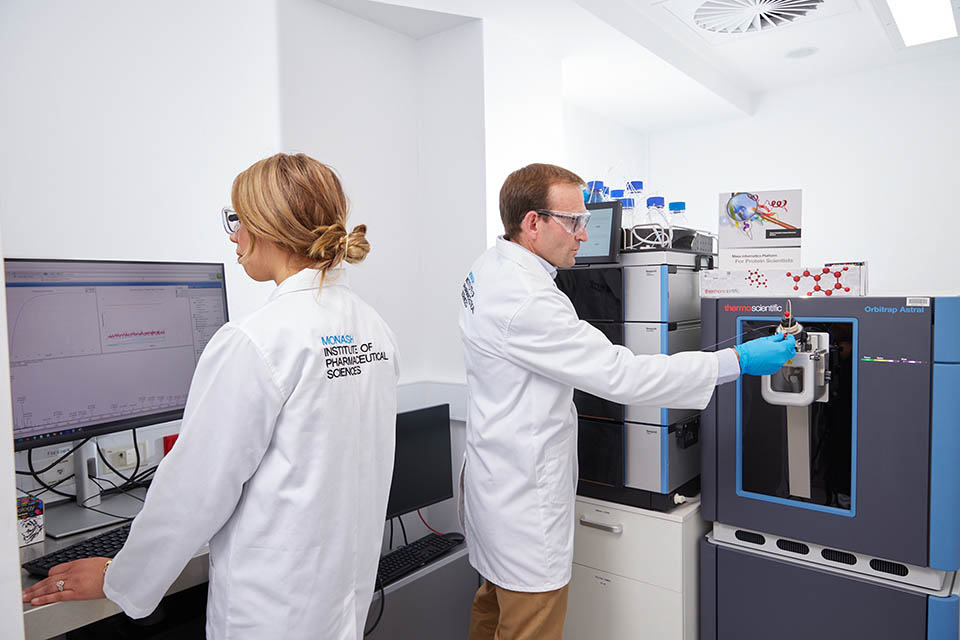
Australian research institutes are using Thermo Fisher’s analytical technology to support research and development of new therapeutics.
Revolutionising cancer care
Advances in genomic testing enable increasingly rapid insights from a patient’s genetic data, providing information that can help physicians tailor cancer treatments.
‘It used to be that you’d spend all the time on the science. Now the tools allow you to spend more time on the solution, because they’ve come so far,’ says Broughton.
SydPath pathology laboratory at St Vincent’s Hospital, Sydney, has embraced one such instrument with remarkable results. In 2020, SydPath partnered with Thermo Fisher to become the first laboratory in Australia to install its next-generation Ion Torrent Genexus™ Integrated Sequencer.
‘We took a punt on a Thermo Fisher instrument that was as yet untested in Australia,’ says Dr Michael Krigstein, head of Molecular Pathology at SydPath.
The Genexus system is a highly automated genetic sequencing platform designed to support rapid genomic profiling across a range of research applications, including oncology and haemotological malignancy research.
SydPath has incorporated the Genexus system into its independently developed and validated molecular testing workflows. According to SydPath, these workflows enable the laboratory to identify genetic mutations in tumour and haematological samples. This provides molecular information that oncologists and haematologists can use to inform patient management and treatment decisions.
With an automated process that takes samples through to report, the Genexus system can run continuously for 18 to 30 hours. SydPath says using the system within its workflows has contributed to significantly reduced turnaround times.
Patients once endured an anxious 4- to 5-week wait for blood cancer results, or 2 to 3 weeks for lung cancer. Now these results can be turned around in just a few days, or even less in some critical cases. The reduced turnaround time enables molecular results to reach treating clinicians sooner, supporting more timely clinical decision-making.
‘We would never have been able to offer this for our patients with our scientific staffing numbers, without this instrument,’ says Dr Krigstein.
SydPath now profiles two-thirds of all cancer patients in New South Wales who require this testing, processing around 2,500 tumour cases and 3,000 blood cancer cases each year. The department has grown from just 2 scientists to a team of 8. SydPath now has 3 Genexus integrated sequencers operating in the lab.
‘Our reputation has been enhanced now, where we provide the fastest turnaround time in the market. That’s how our relationship with Thermo Fisher grew over time, particularly with this instrument and the work that we’re doing,’ says Dr Krigstein.
‘Maybe the ultimate compliment to our lab has been that most hospitals around the state are currently trying to do exactly what we do and recreate it.’
But the reality behind the data is always front of mind.
‘It’s ultimately a human being who cannot move forward with their treatment plan until this result comes back,’ says Dr Krigstein. ‘It has fundamentally changed what people expect as an appropriate time to get results for these important tests.’
Clinical breakthroughs in myeloma testing
Each year, around 2,600 Australians are diagnosed with multiple myeloma, an incurable but treatable blood cancer.
Diagnostic testing is needed for both the initial diagnosis and to actively monitor the disease to determine if a patient is about to relapse. This typically requires frequent bone marrow biopsies, an invasive procedure that can only test a section of tissue, which risks missing the disease.
In a major clinical breakthrough, Thermo Fisher has developed a highly sensitive blood test through its protein diagnostics business that can identify proteins at previously undetectable levels.
‘We actually have one of the first clinically validated in-vitro diagnostic systems in this space for myeloma,’ says Christel Helmers, Thermo Fisher Commercial Director, Protein Diagnostics.
The simple blood test can provide enough data for clinicians to delay a bone marrow biopsy, sparing patients a painful procedure.
‘Patient comfort and patient experience is really important. This test helps guide that and what therapeutics may or may not be working,’ says Helmers.
The Alfred hospital in Melbourne, a recognised leader in multiple myeloma research and treatment, has partnered with Thermo Fisher to embed this technology in its specialised testing program. The serum test is available for active monitoring of myeloma patients.
Moving into the age of biology
Public understanding of genomics and targeted therapies is growing rapidly, and biological science is changing everyday life.
‘More people today know about PCR tests and DNA than ever before,’ says Broughton. ‘They know about markers, they understand about targeted therapy, it’s becoming a real-world part of life. For Thermo Fisher, it’s a great time to support this adoption and the integration of it into the everyday world. Not just in Australia, but also globally. The future is very bright.’
As the next chapter of scientific investment unfolds, Thermo Fisher continues to push boundaries to strengthen scientific capability, support customers to redefine patient care and improve healthcare outcomes.
‘That’s the impact that gets us up in the morning and drives us as a team,’ says Broughton. ‘It’s not just providing the science, it’s helping translate it into real community impact for Australia.’
How Austrade can help
The Australian Trade and Investment Commission (Austrade) supports foreign investors to establish and expand operations in Australia. Our experts in Australia and around the world can help you through every stage of your investment journey.
We offer the latest industry insights, connections with key stakeholders and decision-makers, and virtual or physical site visits to Australia. Thousands of foreign businesses have worked with us to tap into the Australian market.
For information on investment opportunities in Australia, contact an Austrade investment specialist.
Go further, faster with Austrade
Subscribe to the Investment Update newsletter to find out about new investment opportunities, insights and investor success stories across Australia.