The signing of the 1971 landmark purchase agreement with the Hamersley iron ore mine in Western Australia was a vital turning point for both Australia and newly founded South Korean steelmaker POSCO.
South Korea lacked the domestic reserves of iron ore and coking coal POSCO needed for steelmaking. Australia presented an ideal solution as an emerging, world-class resource supplier. That historic iron ore purchase heralded POSCO’s entry into the Australian resources market and helped cement Australia as a primary resource exporter.
Ten years later, in a strategic move, POSCO made its first direct investment in Australia in a joint venture with Rio Tinto to manage the Mount Thorley coal mine in New South Wales.
Since then, POSCO has grown into one of Australia’s largest single private-sector customers, buying around A$8–10 billion worth of iron ore, coal and lithium concentrates each year. Over the course of the 55-year relationship, the South Korean steel giant has imported more than 1.5 billion tonnes of resources from Australia.
‘I think the secret to our success in Australia is prioritising trust and long-term partnership over short-term profit,’ says Chulkyoo Lee, Vice President of POSCO’s Energy Materials Development Office. ‘Australia is very important for POSCO. It’s an important area to invest in and a valuable asset for us.’
Today, POSCO is shifting its relationship with Australia beyond resource-buying and the traditional ‘dig and ship’ model to become an active, collaborative partner in Australia’s green energy future.
POSCO has made landmark investments in Australia’s critical minerals and clean energy supply chains, including a multibillion-dollar stake in Western Australian lithium projects to power the global electric vehicle transition.
Austrade supports Australian growth
Since 2021, Austrade has supported POSCO with advice and information on government policies, regulations and market updates. It has facilitated introductions to government, industry and research organisations, supported POSCO researchers travelling to Australia, and collaborated with Australian clean energy innovators.
‘Austrade often introduces good opportunities for POSCO to invest in Australian research,’ says Lee. ‘[Austrade also informs us] if there are changes in regulations or other important information. This is very helpful and we always appreciate Austrade for this kind of information.’
Austrade continues to help POSCO navigate Australian systems and connect with local researchers, suppliers and green tech developers.
Working towards green steel
As the global steel industry pivots toward low-carbon production, POSCO is reshaping how steelmakers approach sustainability.
Traditional steelmaking generates around 2.8 gigatonnes of carbon emissions each year. By comparison, green steel is made without fossil fuels, using green hydrogen instead of coal to reduce iron ore to iron metal.
Green steel, powered by renewables, is one solution POSCO is exploring to reduce the steel industry’s carbon footprint. With its abundant renewable resources and vast iron ore reserves, Australia is uniquely positioned to play a lead role in this green steel transition. And as the world's leading iron ore producer, reducing emissions in steelmaking is crucial for Australia.
As part of POSCO’s objective to develop more-sustainable products, the steelmaker is also targeting clean energy opportunities in rechargeable battery production. Its battery materials business arm has been in development for more than 15 years.
Investing in critical minerals research in Australia
Keen to leverage the strong research ties between Australia and South Korea, POSCO set up a Critical Minerals R&D Lab in Western Australia in February 2025. It was the first resource-focused research facility established overseas by a Korean company and signified the growing international interest in Australia as a critical minerals innovation hub.
The lab aims to develop processing technologies for the critical minerals and raw materials POSCO needs for its steel and battery businesses. These include iron ore, coal, lithium, nickel and rare earth elements. Rather than conducting experiments directly, POSCO’s goal is to feed laboratory research into commercial production by connecting South Korean technology with Australian expertise.
Jin-chul Baung, Vice President of POSCO Holdings, heads up the small team of Korean researchers and scientists at the Critical Minerals R&D Lab.
‘Our mission is to act as a collaboration hub, connecting POSCO Group in Korea with Australia’s leading research organisations, universities and industry partners in the critical minerals sector,’ says Baung.
‘Ultimately, our goal is to build a partnership that is driven not only by resources and investment, but also by innovation and technology-based, long-term collaboration.’
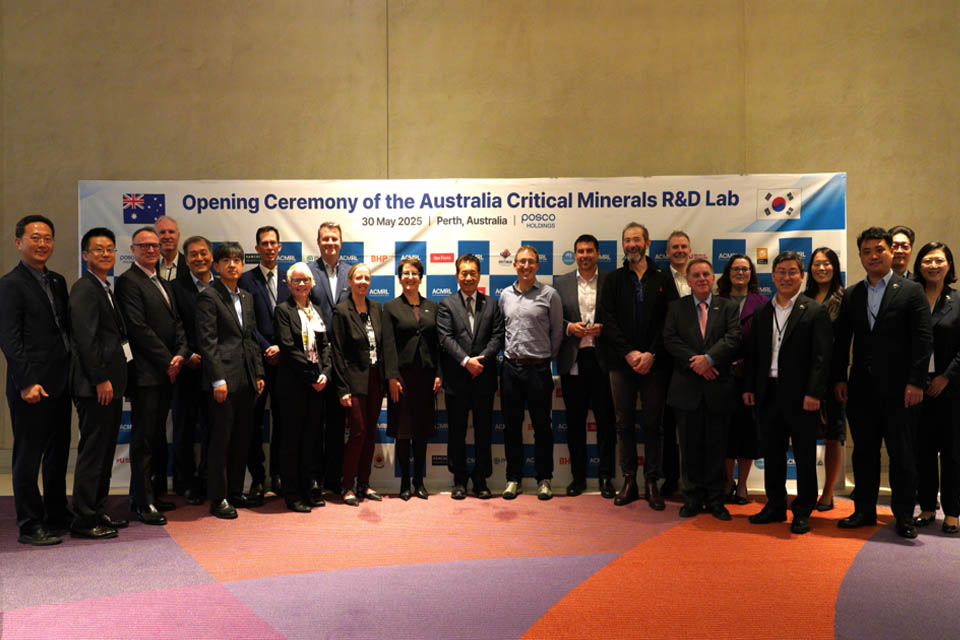
POSCO’s Critical Minerals R&D Lab signified the growing international interest in Australia as a critical minerals innovation hub.
Partnering with Australian universities and research organisations
In its first year of operation, POSCO’s Critical Minerals R&D Lab has built an extensive collaborative network across Australia. It’s now partnering with leading Australian universities and research organisations across a range of projects.
Two of these are currently underway, with CSIRO looking into how Australian iron ore can be used in new, lower-carbon steelmaking processes.
‘We believe this type of research can create mutual value by improving the marketability of Australian iron ore while supporting POSCO’s decarbonisation journey,’ says Baung.
The South Korean steelmaker has a long and trusted relationship with Australia’s national science agency. POSCO has even embedded its own researchers in the CSIRO laboratory to collaborate on joint projects.
‘We’ve had work that goes way back with POSCO. We’ve got people who’ve worked in the iron ore space for a long time, 50-plus years actually,’ says Mark Dorreen, Research Director at CSIRO Mineral Resources.
‘POSCO is very ambitious about advancing the technology that they use. That’s why we like working with them, because we know that they want to try new things and make them work.’
POSCO formalised its strategic partnership with CSIRO in September 2025, signing a 5-year Memorandum of Understanding. Together, the 2 organisations will advance joint research on critical minerals and green metals technology.
As part of this agreement, POSCO and CSIRO launched the inaugural CSIRO-POSCO Group Critical Minerals Forum to strengthen global research collaboration. The 2025 event, exploring lithium refining technologies, brought researchers, academics and industry experts from South Korea and Australia together for the first time. Future forums will focus on low-carbon ironmaking, reflecting the evolving priorities of the critical minerals and steel industries.
‘Our connection to POSCO fits nicely into this brief of how Australia maintains and increases the value of what it’s doing with iron ore,’ says Dorreen. ‘If it’s working with a company so they can add value by processing onshore, that’s good news for Australia.
‘That’s a genuine collaboration, versus what is often classed as collaboration but really means that one of the collaborating parties does all the work, and the other realises most of the benefit. It feels a lot more genuine in that both parties can realise and benefit from the work.’
Collaborating with industry and nurturing talent
Beyond research institutes and universities, POSCO is engaging with Australia’s leading mining companies, setting a precedent for cross-industry cooperation.
‘We regularly exchange ideas and discuss areas of mutual interest with companies such as BHP, Hancock Prospecting, Rio Tinto, PLS and so on,’ says Baung. ‘These conversations help us better understand industry trends and identify potential areas for collaboration.’
This has led to strategic partnerships with BHP to develop HyREX, POSCO’s proprietary hydrogen reduction ironmaking technology.
By integrating with Australia’s broader innovation ecosystem, POSCO is helping solve industry-wide challenges. This also means building human capability and nurturing a skilled talent pipeline to support these future industries.
The Critical Minerals R&D Lab plans to double its workforce in the coming year by hiring local Australian talent, specifically PhD graduates in mining or mineral processing. To this end, POSCO is launching a scholarship program for undergraduate students at Western Australia’s Curtin University. The program will help foster the next generation of bright minds in the critical minerals sector.
‘We’re committed to supporting the development of future talent,’ says Baung.
Securing the future
At a time of growing uncertainty in global supply chains, the Australia-Korea relationship is more important than ever – and collaboration is at the centre.
By combining Australia’s world-class resources with advanced Korean technology, POSCO and Australia are working together to strengthen supply chain resilience and accelerate the energy transition.
The trusted partnership is driving both economic security and clean energy innovation on the path to net zero.
Despite the shifting global environment, Australia’s geopolitical stability, rule of law and wealth of natural resources continue to make it one of the world’s safest investment markets.
‘As uncertainty increases, Australia’s value as an investment destination is becoming even more prominent,’ says Lee. ‘This makes it one of the most reliable and attractive partners for global companies looking for supply chain security.’
How Austrade can help
The Australian Trade and Investment Commission (Austrade) supports foreign investors to establish and expand operations in Australia. Our experts in Australia and around the world can help you through every stage of your investment journey.
We offer the latest industry insights, connections with key stakeholders and decision-makers, and virtual or physical site visits to Australia. Thousands of foreign businesses have worked with us to tap into the Australian market.
For information on investment opportunities in Australia, contact an Austrade investment specialist.
Go further, faster with Austrade
Subscribe to the Investment Update newsletter to find out about new investment opportunities, insights and investor success stories across Australia.