Dutch tech company Skytree extracts carbon from the air and puts it to good use, helping reduce carbon emissions across industries, and even moving into carbon negativity.
Now, it’s launching in Australia, empowering local industry, and accelerating the pathway to net zero emissions.
Skytree’s story begins in orbit, when its founders developed a CO₂ scrubber technology to clean the air in the International Space Station.
‘That is the core IP and the genesis of Skytree,’ explains Ameen Bou Diab, Skytree’s senior project development manager for APAC, who is leading the expansion in Australia.
‘But it wasn’t necessarily scalable or commercial.’
In 2014, the company made the move ‘from cosmos to carbon,’ he says.
‘We pivoted to Earth.’
Capturing and storing carbon to achieve negative emissions
Today, Skytree’s focus is on Direct Air Capture technology; carbon from the atmosphere and repurposing it or storing it.
Skytree has 2 core missions, Bou Diab explains. Carbon capture and utilisation (CCU) projects carbon from the air. Carbon is a gas already used in commercial enterprises; for example, in greenhouses, or for carbonating fizzy drinks.
Carbon capture and storage (CCS) projects, on the other hand, carbon from the atmosphere and store it away, deep underground. Here, Skytree is working with large organisations that already capture their emissions, allowing them to add historic to their operations.
‘The biggest opportunity to decarbonise is by capturing and storing historic emissions,’ Bou Diab says.
‘We actually achieve negative emissions. You can take something that has been out there in the air and put it underground, creating storage for thousands and thousands of years.
‘Then, you can claim carbon removal as a credit, and that can be sold on the voluntary carbon market.’
This is an immediate solution for decarbonisation, he adds. ‘Speed is becoming of the essence; there’s urgency to get to net zero.’
Market entry supported by Austrade
Austrade has been working with Skytree since 2024, facilitating networking opportunities and connecting the team with potential clients and key partners.
In 2026, Skytree CEO Rob van Straten visited Australia after meeting representatives at an event in the Netherlands, organised by Austrade. During this two-week trade mission, van Straten was invited to attend the Renewable Fuels Summit in Sydney.
Opportunities like this have helped pave the way for success in Australia, Bou Diab explains.
‘Austrade has helped us understand the local market much more quickly,’ he says.
‘They’ve introduced us to relevant companies who are thinking about these problems; how they’re going to produce clean fuel and where they’re going to get carbon from.’
Commercially, this is a relatively new technology. Having Austrade’s support brings credibility not only to Skytree as a business, but to the tech itself.
‘That removed a lot of discomfort, doubt and disbelief,’ Bou Diab says.
‘It allowed people to build conviction that Direct Air Capture should play a role in our national decarbonisation journey.’
Skytree’s target is to 10 million tonnes of CO₂ from the atmosphere, globally, by 2030. Bou Diab believes almost a third of that could be achieved in Australia alone.
‘Australia has a very large emission-intensive industry profile,’ he says. ‘It just makes sense to really double down on negative emissions here.’
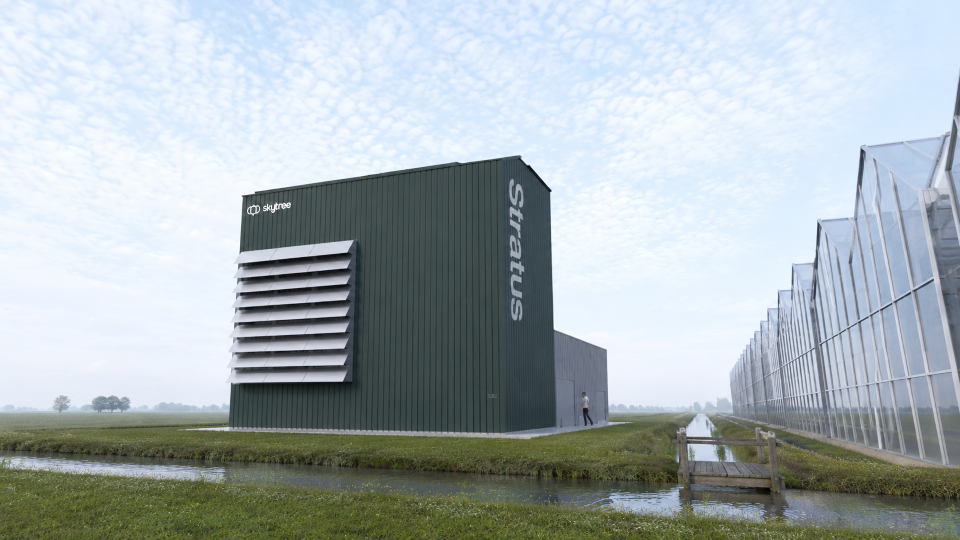
Skytree’s Direct Air Capture system captures carbon from the atmosphere and repurposes it or stores it underground.
The Australian opportunity in carbon capture
Skytree’s initial commercial focus in Australia is implementing CCU projects — capturing carbon dioxide from the air and redistributing it as an alternative to fossil-based CO₂.
The tech is designed to integrate within existing technology and operations, meaning they’re fast to install, and commercially competitive today.
Carbon is a commodity, Bou Diab explains, with fossil-fuel–based carbon already in use in greenhouses, beverage factories and packaging manufacturers, to name a few. Allowing these organisations to self-capture their CO₂ can save time and money, while also reducing reliance on the global fossil CO₂ supply chain.
Future uses of captured carbon
In the future, captured carbon could also be used to make electrofuels (eFuels) such as e-Sustainable Aviation Fuel (eSAF) and eMethanol. These fuels are produced by combining captured CO₂ with green hydrogen to create synthetic alternatives to the bio-based fuels that currently dominate the low-carbon fuels market.
While currently more expensive, these eFuels can be produced at a much larger scale and deliver greater emissions reductions.
By enabling the domestic production of synthetic fuels, Skytree’s technology can also support Australia’s long-term fuel security.
A complementary growth story
In Australia, Skytree has projects underway in Queensland, Western Australia and South Australia, spanning greenhouses, carbonated drinks factories and CCS projects.
The business is also strongly considering manufacturing locally in the future.
For a product like this, there is a large and versatile market here, Bou Diab says. Skytree’s goals are also aligned with Australia’s net zero emissions goals, and support a shift towards more secure, sovereign sources of CO₂ for local industry.
‘Australia is the right country because of the versatility of the markets, the vast amount of land, and of course the renewables, which are how we’re going to power our systems,’ Bou Diab says.
‘As we’re scaling our systems, we’re also allowing the country to scale our renewable ambitions and meet our net zero targets faster.’
‘Australia has the right conditions to become a leader in carbon utilisation,’ says Rolf Karst, Investment Director, Austrade. ‘There is strong industrial demand for CO₂, abundant renewable energy and a clear focus on decarbonisation, creating real opportunities to scale CCU projects.’
A-EU FTA to support growth
Skytree’s expansion in Australia will benefit from the Australia-European Union Free Trade Agreement (A-EUFTA). Once fully implemented, the agreement will remove tariffs on Australian energy and resources exports to the EU. The agreement will also improve investment certainty for EU companies operating in Australia in sectors critical to Europe’s energy security, including decarbonisation.
The A-EUFTA strengthens Australia’s position as an attractive destination for renewable energy investment, underpinned by its abundant natural resources.
The agreement also allows for better collaboration between EU-based and Australian companies. The EU is ‘one step ahead’ in terms of regulatory frameworks for carbon capture, Bou Diab says.
‘It means we have the right frameworks and systems in place to exchange knowledge, allowing Direct Air Capture to be more widely adopted.’
Austrade assistance
Austrade supported Skytree in its Australian launch by providing insights and advice around Australia’s CO₂ market; introductions to potential partners and customers, including state agencies, project developers and federal agencies; and creating visibility through access to industry events such as the World Hydrogen Summit.
How Austrade can help
The Australian Trade and Investment Commission (Austrade) supports foreign investors to establish and expand operations in Australia. Our experts in Australia and around the world can help you through every stage of your investment journey.
We offer the latest industry insights, connections with key stakeholders and decision-makers, and virtual or physical site visits to Australia. Thousands of foreign businesses have worked with us to tap into the Australian market.
For information on investment opportunities in Australia, contact an Austrade investment specialist.
Subscribe to the Investment Update newsletter
Find out about new investment opportunities, insights and investor success stories across Australia.