When David Pollington and his friend Anton Rohner opened an office in Hobart in 2017, they already had decades of renewable energy experience under their belt. Years earlier, the pair had built wind farms together across Australia, China, India and New Zealand for Roaring 40s, Hydro Tasmania’s former renewable energy joint venture.
This time, under the umbrella of multinational UPC Renewables, they set out to build a business that would not only develop renewable energy projects, but also construct, own and operate them.
By the end of 2017, the team of half a dozen people was working on projects in Tasmania, New South Wales and Victoria. Soon after, Philippines-based energy company ACEN (then known as AC Energy) came to Australia to see what they had built.
ACEN liked what it saw, and in January 2018, it entered the Australian renewable energy market with a 50% stake in the UPC business. This stake increased over time to full ownership in 2023, and ACEN Australia was born – inheriting a growing pipeline of solar and wind projects and a small but ambitious team.
Today, ACEN Australia employs around 140 people. It operates 2 of the country’s largest solar farms and is completing construction of its first battery, giving the company close to 1 GW of operating renewable energy capacity, with around 13 GW more in the pipeline.
It’s a substantial local presence for a company whose major shareholder, the Ayala Corporation, has been operating for more than 180 years and is looking for opportunities to grow well beyond the Philippines.
Austrade support
Austrade provided crucial support for ACEN’s entry into Australia, supplying visa information and connecting the team in Australia with a skilled workforce and key government stakeholders.
As ACEN’s Australian business has grown, Austrade has kept in touch with the company’s progress, checking in on how projects are tracking on the ground.
Austrade advisers in Australia and the Philippines continue to keep ACEN International up to date with developments in Australia’s renewable energy sector, sharing market and investment information.
Worth navigating a complex environment
Along with opportunities, Australia has also presented a few hurdles along the way. Patience has been a necessary virtue for ACEN, something David Pollington, now ACEN Australia’s Managing Director, says is important in the renewables sector.
‘The country is seen as politically and geologically stable – an ideal place for a long-term investment,’ David says. ‘But it’s a slow burn, if you like. Things don’t happen fast in Australia.’
That patience has been tested at times. Pollington admits that Australia, in his experience, has been the hardest place to build renewable energy. Three levels of government approvals, a power grid built for a different era, and community resistance have added to the barriers.
But he also says Australia’s strengths in the renewables sector far outweigh the problems, and ACEN’s goals are tied directly to the nation’s energy transition.
‘We have a substantial amount of coal generation that is reaching the end of its design life. Regardless of where you sit on climate change, there’s an opportunity – that generation needs to be replaced,’ Pollington says. ‘Solar and wind are certainly cheaper than building a new coal-fired power station or a gas-fired power station.’
He points to state governments building out renewable energy zones, and a broader national shift towards clean energy, as reasons ACEN sees Australia as a long-term opportunity.
An intentional approach to community and Country has been key to ACEN’s project development, helping it build one of Australia’s most closely watched renewable energy portfolios. ACEN views projects as generational relationships rather than transactions. This is a lesson learned first, and most deeply, on the company’s flagship project, New England Solar.
Learning through building
New England Solar, near the town of Uralla in northern New South Wales, was ACEN’s first major construction project in Australia. It was also the company’s first experience engaging a regional community at this scale, reports Tim Greenaway, Head of Construction and Engineering at ACEN Australia.
‘We were really conscious of that this was our business’s first major project in Australia,’ Greenaway says. ‘For lots of reasons, it had to go well. And we wanted it to go well – we wanted to build long-term relationships with the communities.’
The project brought around 400 workers into a town of roughly 3,000 people. It would eventually deliver 400 MW of solar power across 963,000 panels and around 13,000 trackers – what Greenaway describes as ‘a huge logistics project’.
But before construction began, the region was in drought. Water quickly became the community’s major worry.
‘One of the biggest concerns was that the community didn’t want us to be taking water from their drinking water supply, and we said that we wouldn’t do that,’ says Greenaway.
ACEN explored alternative sources, including the local council’s wastewater treatment plant and trucking water in from off-site sources.
Upgrades to the roads leading into the site, including straightening a dangerous stretch of the main route to Armidale, were a big undertaking and well received. Although the works were disruptive, ‘we certainly didn’t receive negative feedback – people were very happy with what we were providing them,’ Greenaway says.
In consultation with the project’s 7 landowners, Greenaway’s team worked to design the solar farm around continued sheep grazing, burying cables and installing screening so livestock could safely share the land.
‘We spent a lot of time with them looking at the design of the project – where water might be retained, where fences might go – trying to make sure we designed the project to facilitate sheep grazing in the future,’ says Greenaway. ‘As far as we were aware, it hadn’t been done at that point.’ This approach has since become common practice across the industry.
‘A lot of it for me was making sure we delivered on our promises,’ Greenaway shares. ‘If we said we were going to do something by a certain time, or approach it a certain way, we made sure we did it. If we didn’t, we were upfront about that. We always wanted to be open, honest and transparent – those were our guiding principles.’
A conversation, not a negotiation
As well as consulting the regional community, ACEN Australia – then still known as UPC Renewables – began engaging with the Anaiwan people, the Traditional Custodians of the New England Tablelands, well before construction started.
Anaiwan Elder, Cheryl Kitchener, became involved as a Registered Aboriginal Party for the project. It is a formal role under New South Wales law that allows Aboriginal people to help identify cultural values on Country ahead of major developments.
Kitchener started the engagement with some uncertainty about what a solar farm would mean for Country. ‘To be honest, I had no idea what an actual solar farm would look like,’ she says. But having lived and worked in the Hunter Valley, an area impacted by mining, she understood the difference between resource extraction and renewable energy.
‘What I knew for a fact is that having solar is a very different process,’ she says. ‘The panels sit on top of the landscape – biodiversity can still live in the landscape, culture and heritage can still survive in that landscape, and they can actually survive beside each other. You don’t have to completely destroy one for the other.’
That understanding shaped how the Anaiwan community approached the company. ‘ACEN actually listened to us. They gave us a voice,’ Kitchener says. ‘We didn’t think it was a negotiation. We just thought it was a conversation.’
Trust wasn’t automatic. It took time to develop a relationship, and the Registered Aboriginal Parties were open-minded but apprehensive.
‘When we first met ACEN, we were suspicious, and we had the right to be. It wasn’t just a learning curve for ACEN – it was a learning curve for us too,’ Kitchener says. ‘It was the first time that a company actually sat down at the table and really took us seriously.’
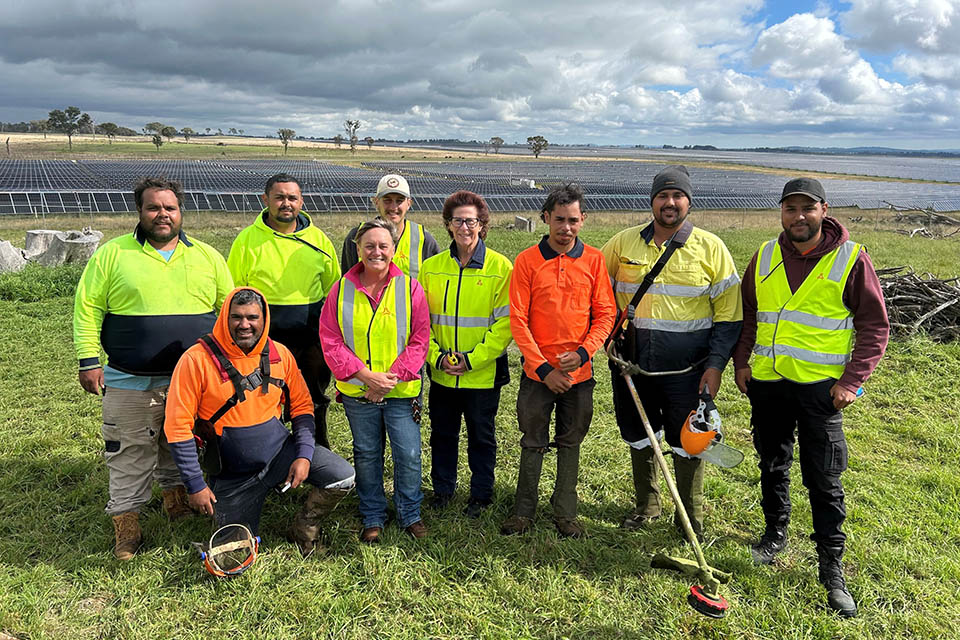
ACEN has built close ties with the communities where it is building renewable energy projects.
Respect on both sides
Central to how the relationship between ACEN and the Anaiwan community has endured is a willingness, on both sides, to have difficult conversations without walking away from the table.
‘We don’t always agree on things,’ Kitchener says. ‘We’re people, we’re humans – not everybody agrees with everything that each other does. But we can have hard conversations, we can get cranky with each other, but we come back to that table and talk respectfully.’
Sometimes that has meant taking a breath and returning later. ‘Sometimes we’ve had to walk away from the table and just breathe,’ adds Kitchener. ‘When we go back to the table, let’s go back with a positive attitude – how can we make this better? Because it’s not about us as individuals, it’s about generational impact.
‘It’s not about compromising values. It’s about understanding that everybody has unique needs, and how do we actually respect that, but still move forward in a positive way?’
That mindset lines up with how ACEN Australia’s leadership thinks – consistency, respect and communication are key.
‘Our goal is to work with communities all the way through – from development through to operations – so that they treat us as a valued member of the community we’re in,’ says Pollington.
For Kitchener, that leadership style has been important in the relationship between ACEN and the Anaiwan people.
‘The company is only as good as its leadership,’ she says. ‘If you don’t have strong leaders, if you don’t have forward-thinking leaders – leaders that think outside the box – it doesn’t matter about the money. Nothing will happen.’
Country and community at the centre of decisions
ACEN’s Social Investment Program provides funding across its projects. But rather than deciding where the money goes, the company hands that responsibility to the community.
‘We run it through a local community reference group,’ Pollington says. ‘People make applications for funding, and the reference group assesses the applications. ACEN administers the group and hands over the money, but the community runs it.’
In Uralla, that fund has supported a golf club’s major fundraising tournament, 2 community defibrillators, a local bike repair shop, and a knowledge-sharing project between the Anaiwan community and the local school, among many others.
‘We’re not there to give handouts,’ Pollington says. ‘We’re wanting to give a hand up.’
Developing skills, not just access
Beyond the funding program, ACEN has worked with the Anaiwan community to build an ongoing Aboriginal-led business managing the cultural heritage sites scattered across the New England project.
‘Part of those conversations was to look at developing an Anaiwan small business,’ Kitchener says. ‘We’ve got a business that does a lot of the land management up there and looks after a lot of those cultural sites.’
What began as land management – clearing grass to reduce fire risk, maintaining fenced heritage sites – has since grown.
‘The biggest threat to solar farms is fire, so making sure the grass is kept low is really important,’ says Kitchener. ‘Sheep can only do so much, but then the crew come in and do that work. Now they’re broadening out – working underneath the panels, getting training in other aspects, assisting electricians, which is really important.’
Tim Greenaway has seen that shift firsthand on site. ‘They mowed, they got rid of the weeds, they really tidied up each of those sites – sites they hadn’t had access to for many years,’ he says.
‘As a result of that maintenance work, they’re now doing other work for us as well. We’re building capability in those areas and hopefully building a business with them that they can take to other solar farms.’
For Kitchener, the wider impact runs through both culture and Country. ‘You see a mine site, and there’s a lot of destruction of biodiversity and culture. You see a solar farm, and there is protection of biodiversity and culture,’ she says.
Kitchener has watched native species return to areas fenced off from grazing stock. ‘When you’ve got healthy Country, you’ve got healthy people,’ she says.
Sharing knowledge across Country
ACEN’s relationship with the Anaiwan community has also connected them with Traditional Owners from the opposite side of Australia.
When the Yindjibarndi people in Western Australia were considering a joint venture with ACEN, Yindjibarndi Elder Michael Woodley travelled to New England to meet the Anaiwan community first – without anyone from ACEN present.
‘They came to New England and met with the Anaiwan people, and talked about us – without us there,’ Pollington says. ‘And that relationship grew.’ A joint venture, the Yindjibarndi Energy Corporation, followed, along with the company’s first project finance deal – a 75 MW solar project. Read a case study about the partnership between ACEN and the Yindjibarndi Energy Corporation.
On site, ACEN has also supported cultural exchange between its own staff and the Anaiwan community. ‘We’ve had some culture camps with the men’s group,’ Kitchener says. ‘We’ve got an Anaiwan men’s group that takes some of the ACEN staff out on Country and immerses them in culture – they get to make coolamons [traditional vessels], and they go out and see other sites.’
Greenaway, who took part in one of the camps, spent a weekend learning to make traditional tools. ‘It was an amazing weekend,’ he says. ‘We’ve learned a lot. It’s been an amazing experience.’
A shared future
For ACEN, there’s a through line connecting its business case for renewable energy in Australia and its approach to community and Country: clean energy and healthy Country don’t have to compete with each other. As a result, everyone – people and the environment alike – can thrive.
‘We didn’t want to stop development,’ Kitchener says. ‘We see having solar in our Country as a generational benefit – not just for Aboriginal people, but for all people. We wanted to support that, and we strongly support that.’
The perspective ACEN aims to bring to every project is to come to the table prepared to listen. Be ready for the conversation to be hard sometimes, but trust that a strong, lasting relationship – built on respect for people and Country – is what makes a shared goal like a cleaner energy future achievable.
For Anaiwan people, this translates to self-determination over Country and safeguarding it for future generations.
‘We didn’t want to be standing outside the fence trying to get in,’ Kitchener says. ‘We wanted to be inside the fence, working to be part of a bigger thing in our community.’
How Austrade can help
The Australian Trade and Investment Commission (Austrade) supports foreign investors to establish and expand operations in Australia. Our experts in Australia and around the world can help you through every stage of your investment journey.
We offer the latest industry insights, connections with key stakeholders and decision-makers, and virtual or physical site visits to Australia. Thousands of foreign businesses have worked with us to tap into the Australian market.
For information on investment opportunities in Australia, contact an Austrade investment specialist.
Go further, faster with Austrade
Subscribe to the Investment Update newsletter to find out about new investment opportunities, insights and investor success stories across Australia.