In 1969, 2 observatories in rural Australia were instrumental in beaming the first extraordinary moments of the moon landing to Earth – showcasing science that would change the world forever.
In the 50+ years since that historic event, Australia’s space sector has grown at an astronomical pace. The sector has an annual turnover of A$4.6 billion and employs around 17,000 people across 620 businesses. Australia’s specialised space businesses turn over A$1.1 billion a year. Private-sector investment in the sector reached A$289 million in 2024.
Today, Australia is known for its advanced space technologies, skilled workforce, and innovative research and development. We are launching and returning rockets alongside global space organisations; developing, manufacturing and operating advanced satellites and other technologies; and partnering with international space agencies to advance research and exploration.
Still, in terms of potential, we’re arguably just scratching the surface. As space tech evolves from research, development and testing into commercialisation, Australia is emerging as a prime location for smooth, efficient and economically smart operations.
Clear land and clear skies
When it comes to space innovation, Australia has always had a geographical advantage. We are a nation of wide open spaces, with huge areas of sparsely populated land, low air traffic and minimal digital noise to manoeuvre around. Relatively speaking, that means easier access to space, and easier Earth observation from space.
This is combined with a stable economic and political landscape, plus advanced digital infrastructure and connectivity.
The climate is also favourable. The Indigenous-owned Centre for Appropriate Technology (CfAT) Satellite Enterprises in Alice Springs in the Northern Territory has 250 cloud-free days per year; low light pollution; stable atmospheric conditions; and clear night skies.
Its remote location also allows for a clear line of sight 5 degrees above the horizon, and unique observations hidden to Northern Hemisphere counterparts.
Favourable regulation
The Australian Space Agency (ASA) Office of the Space Regulator ensures the safety of space activities, while streamlining regulation and removing barriers to participation.
Australia has agreements with the world’s major space agencies, including NASA, the UK Space Agency, Japan Aerospace Exploration Agency and the European Space Agency, to facilitate smooth operations across borders. The ASA also participates in international forums, agreements and arrangements to support international space law, and contributes to regulatory arrangements that shape and enable the space industry.
The Space Industry Association of Australia (SIAA) is the national peak body for the Australian space industry. It works closely with Australian governments, international partners, academia, and industry to advance Australia’s space industry and economy.
World-leading local knowledge
Alongside historic expertise in satellite tracking and communications, the Australian workforce brings experience in robotics and engineering, partly spun out of the mining industry.
At the same time, world-class education and research institutions are producing leaders in niche space technologies — think situational awareness capabilities and quantum clocks for positioning, navigation and timing in orbit.
In November 2025, Brisbane-based rocket manufacturer AtSpace entered the record books by launching its Australian-made A01 rocket higher than any other Australian commercial rocket has gone before. After taking off from Southern Launch’s Koonibba Test Range, the rocket flew close to the target altitude of 80 kilometres, validating AtSpace’s hybrid propulsion technology.
For international operators, Australia offers access to institutions and experts for research and development on the ground. There is also a Research and Development Tax Incentive to help offset the costs of R&D activities and encourage innovation.
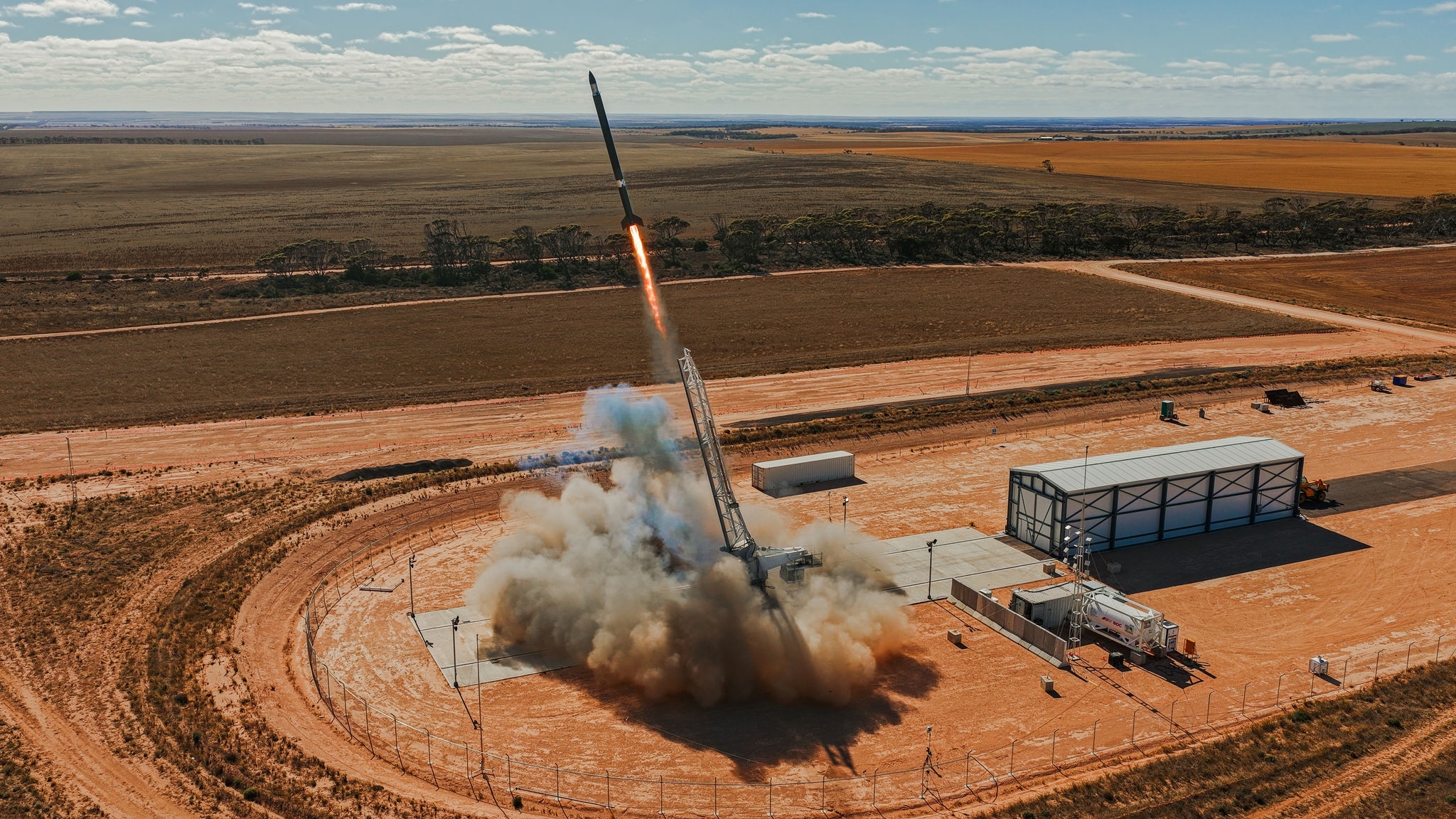
Australian rocket manufacturer AtSpace launching its A01 rocket at Southern Launch’s Koonibba Test Range.
Nationwide infrastructure and connectedness
Australia’s space infrastructure is growing, with space ports and return locations positioned around the country.
For all the benefits of its vast and remote landscapes, Australia is a developed nation with a national and international infrastructure well equipped for quick communication and efficient transport. Major cities allow for flight connections to all major business hubs, and even the most remote locations are (mostly) accessible by road.
International partnerships
The potential of this sector is coming to fruition, with international partnerships emerging fast.
In 2023, NASA chose Australia to conduct its first commercial launch outside of the US. NASA will also partner with Australia for its Artemis mission, returning astronauts to the moon with an Australia-made ‘roo-ver’ in tow.
Singapore’s Equatorial Space Systems (ESS) also launched its Dorado rocket in Australia. ESS has now established an Australian subsidiary and is tapping the market for talent.
CfAT Satellite Enterprises, meanwhile, is engaged in multiple satellite-tracking contracts and development opportunities, globally.
Australia’s world first
In 2024, Southern Launch completed the first liftoff from its 41,000-square kilometre Koonibba Test Range, supporting German company HyImpulse in trialling ‘green’ rocket fuel.
In early 2025, again at the Koonibba Test Range, Californian life sciences company Varda Space Industries completed the first-ever commercial space re-entry in Australia, having taken off from the US. Following 2 more successful re-entries with Southern Launch, Varda recently committed to another 20 re-entries over 3 years.
This partnership makes Australia the first jurisdiction, globally, to deliver routine commercial orbital re-entry operations.
Here, low air traffic means re-entries can be frequent and largely unimpeded. The ASA and the US Federal Aviation Administration worked with Varda and Southern Launch on regulatory and safety requirements for re-entry and to return capsules to Los Angeles within 24 hours of landing.
At the same time, there’s expertise and state-of-the-art kit on site, meaning equipment can be stored and maintained in situ, reducing unnecessary transportation.
A competitive, commercial advantage
The global space sector is continually evolving. Where R&D and innovation was once the domain of governments and institutions, Australia is now seeing commercial applications becoming viable.
It’s here that Australia’s convergence of advantages (both natural and hard-earned) are proving invaluable, positioning the nation’s innovators as leaders among pioneers.
Austrade works closely with the ASA and industry players alike, and can support this growing economy by connecting local and international organisations.
Find out more about investment opportunities in Australia’s space industry.
How Austrade can help
The Australian Trade and Investment Commission (Austrade) supports foreign investors to establish and expand operations in Australia. Our experts in Australia and around the world can help you through every stage of your investment journey.
We offer the latest industry insights, connections with key stakeholders and decision-makers, and virtual or physical site visits to Australia. Thousands of foreign businesses have worked with us to tap into the Australian market.
For information on investment opportunities, contact Adam Pittard, Senior Investment Adviser, Austrade.
For information on trade opportunities, contact Tamara Bell, Senior Global Engagement Manager, Austrade.
Go further, faster with Austrade
Subscribe to the Investment Update newsletter to find out about new investment opportunities, insights and investor success stories across Australia.