Australia, like Europe, is undergoing a rapid energy transition, with both regions facing similar challenges around grid modernisation, renewable integration, and evolving market mechanisms. These technical and financial hurdles are compounded by the need for coordination across jurisdictions, regulatory frameworks, and social licensing. Overcoming these hurdles requires collaboration between government, industry and international partners.
The sheer scale of grid transformation, the complexity of integrating renewables, and the urgency of retiring ageing coal assets create a demanding environment for investors and policymakers. Yet, these challenges are also opening significant opportunities for European investors and technology providers to actively participate in Australia’s net zero transformation.
Australia’s grid modernisation journey
European countries transforming their energy systems know the challenges this brings: intermittency, the complexities of grid modernisation, tensions between market mechanisms and policy imperatives. Australia is navigating a similar journey over a compressed timeframe and across vast distances. Australia also operates 2 distinct wholesale electricity markets.
Australia’s National Electricity Market (NEM) covers the eastern and southern states, spanning over 5,000 kilometres from North Queensland to Tasmania. It’s one of the world’s longest interconnected power systems, comparable to connecting Scandinavia to the Mediterranean, with over 40,000 kilometres of high-voltage transmission.
The Wholesale Electricity Market in Western Australia operates independently, serving 1.2 million customers across 260,000 square kilometres in a grid with no interstate connections.
The NEM functions as a real-time gross pool market with 5-minute dispatch intervals, operationally similar to day-ahead and intraday markets, but with key differences in capacity mechanisms and contract structures.
What distinguishes Australia is the dominance of bilateral contracting and the rapid pace of decentralisation. Over 4.2 million households and businesses now have rooftop solar installations totalling 26.8 GWs.
To put this into perspective, rooftop solar now provides approximately 15% of annual generation in the NEM, the largest single source of clean energy in the grid. The Australian Energy Market Operator (AEMO) released its 2026 Integrated System Plan in June 2026, and it reveals tensions that European policymakers know intimately.
AEMO’s modelling shows that total generation and storage capacity is expected to reach over 300 GWs by 2050 to meet demand growth and decarbonisation targets, essentially tripling the system while fundamentally transforming its composition.
Overall, Australia’s NEM currently has approximately 99 GWs of generation and storage capacity, with coal still providing 45–50% of total electricity generation. The Australian Government’s ambition is 82% renewable electricity by 2030, requiring around two-thirds of remaining coal capacity to retire by 2035. Refer to Figure 1, NEM Capacity, page 13, AEMO 2026 Integrated System Plan.
The ageing infrastructure is also creating reliability risks; however, there is ongoing discussion about system resilience and whether coal assets can be closed on schedule. AEMO’s modelling indicates full unplanned outages could occur around 7% of the time, with partial capacity loss another 17% of the time.
This creates a dilemma: how do you manage the retirement of firm dispatchable capacity when renewable intermittency requires flexible backup? Market signals may say close generators, but grid security might indicate waiting? And to add to the complexity: not all coal-fired power stations are publicly owned.
The rooftop revolution creating demand-side complexity
Australia has an abundance of sunshine. Previous support has seen our household and C&I solar industry scale, where now over 4.2 million households and businesses have rooftop solar.
The Clean Energy Council’s latest data shows that in the first half of 2025, households and businesses installed 1.6 GWs of rooftop solar, the strongest start to any year on record. Battery installations are accelerating even faster. According to Rystad Energy, Australia is currently the world’s third largest market for utility-scale storage behind only the huge economies of China and the US. This is impressive for a country with a population of less than 30 million people.
In the second half of 2025, the Australian Government doubled down on these numbers by subsidising the costs of installing a home battery for Australian households. It was a hugely successful program that has seen over 200,000 home batteries installed in the past 7 months alone, representing 4.7 GW hours. This growth is transforming the way in which the public interact with their energy providers, increasing demand for Virtual Power Plant participation and reducing energy costs in real time.
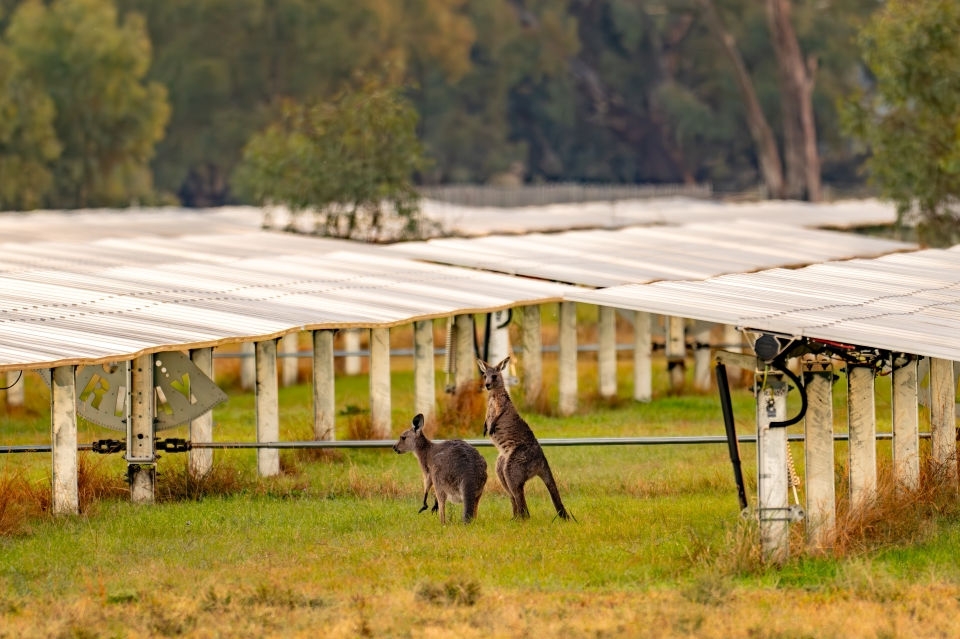
Darlington Point Solar Farm (NSW), operated by Octopus Australia, is one of the largest solar power installations in Australia.
The Australian Energy Council’s reporting on rooftop solar shows installations are exceeding AEMO’s 2030 target projections by 3.3%, reaching an expected 37.2 GWs by June 2030. For the first time in history, AEMO’s Q4 2025 Quarterly Energy Dynamics report showed renewables and storage supplying more than half of the NEM’s energy needs for an entire quarter. Wind generation increased by 29% year-on-year and grid-scale solar was up 15%. Battery discharge nearly tripled to an average of 268 MW, supported by 3,796 MW of new battery capacity added since late 2024.
This extraordinary success in deployment has fundamentally changed grid operation, demand forecasting, and the investment case for utility-scale generation. During mild, sunny periods, we’re now seeing wider daily price spreads and higher intraday volatility. This creates significant opportunities for flexible capacity, batteries, demand response, smart charging infrastructure – and challenges for inflexible baseload.
Investment architecture de-risks transition
Australia has developed a sophisticated framework to attract capital into its grid transformation, and it draws heavily on lessons from European financing mechanisms.
The Rewiring the Nation program addresses what is genuinely Australia’s greatest infrastructure challenge: transmission. We’ve committed billions in concessional financing for Renewable Energy Zones and transmission projects. Agreements with the states of Victoria, Tasmania and New South Wales total over A$7.8 billion in combined federal and state financing for 8 major transmission projects.
This is critical because connection queues are lengthening dramatically.
We have 67 GW of generation and storage projects in the NEM connections pipeline, close to the 73 GW of existing installed capacity, with 30 GW in the application stage, representing 33% year-on-year growth.
The National Reconstruction Fund targets industrial decarbonisation and domestic manufacturing of low-emissions technologies. For European manufacturers and technology providers, this represents a significant opening: Australia has abundant renewable sources, established supply chains to Asia-Pacific markets, and a regulatory environment increasingly aligned with European standards on emissions intensity and sustainability reporting. The fund specifically targets hard-to-abate sectors like steel, cement, chemicals and aluminium where European companies have developed leading technologies.
The Capacity Investment Scheme provides long-term revenue certainty through two-way contracts-for-difference. If market revenues fall below a set floor, government tops up earnings. If revenues exceed expectations, projects repay the surplus. This de-risks investment while protecting taxpayers. The scheme is supporting a target of 26 GW of new renewable generation and 14 GW of clean dispatchable capacity, unlocking approximately A$21 billion in private investment. For European developers familiar with contracts-for-difference, this structure will be immediately recognisable, but with Australian market conditions offering potentially superior returns given current wholesale price dynamics.
Coordination across multiple jurisdictions
AEMO estimates that A$106 billion in grid investment is needed on the NEM through to 2050, with critical transmission projects requiring delivery by the early 2030s to maintain reliability as coal retires. The challenge isn’t just capital; it is coordination across multiple jurisdictions with different planning frameworks, environmental approval processes, and social licensing aspects. Australia’s federal system means energy regulation involves cooperation between federal, state and territory governments.
While European developers are familiar with navigating local planning and regulations, some social licensing aspects like community and First Nations consultation requirements will be new. The Australian Trade and Investment Commission (Austrade) and its state government partners can support international investors to navigate these requirements.
The European-Australian partnership opportunity
Why is Australia looking to partner with European investors? They bring the experience Australia needs, including the ability to manage high renewable penetration, finance complex transmission projects, integrate distributed resources, and navigate multi-jurisdictional regulatory frameworks.
Australia offers abundant renewable resources, available land, a stable regulatory environment, and government financing mechanisms that de-risk early-stage deployment. The Australian Government is providing solid financial support through concessional finance, revenue guarantees and grid co-investment.
Australia’s multibillion infrastructure transformation will occur over the next 25 years, but the most critical investment decisions are happening now. The opportunity for European partners to help shape Australia’s energy future has never been greater.
How Austrade can help
Austrade supports foreign investors to establish and expand operations in Australia. Our experts in Australia and around the world can help you through every stage of your investment journey.
We offer the latest industry insights, connections with key stakeholders and decision-makers, and virtual or physical site visits to Australia. Thousands of foreign businesses have worked with us to tap into the Australian market.
For information on investment opportunities in Australia, contact an Austrade investment specialist.
Subscribe to the Investment Update newsletter
Find out about new investment opportunities, insights and investor success stories across Australia.